


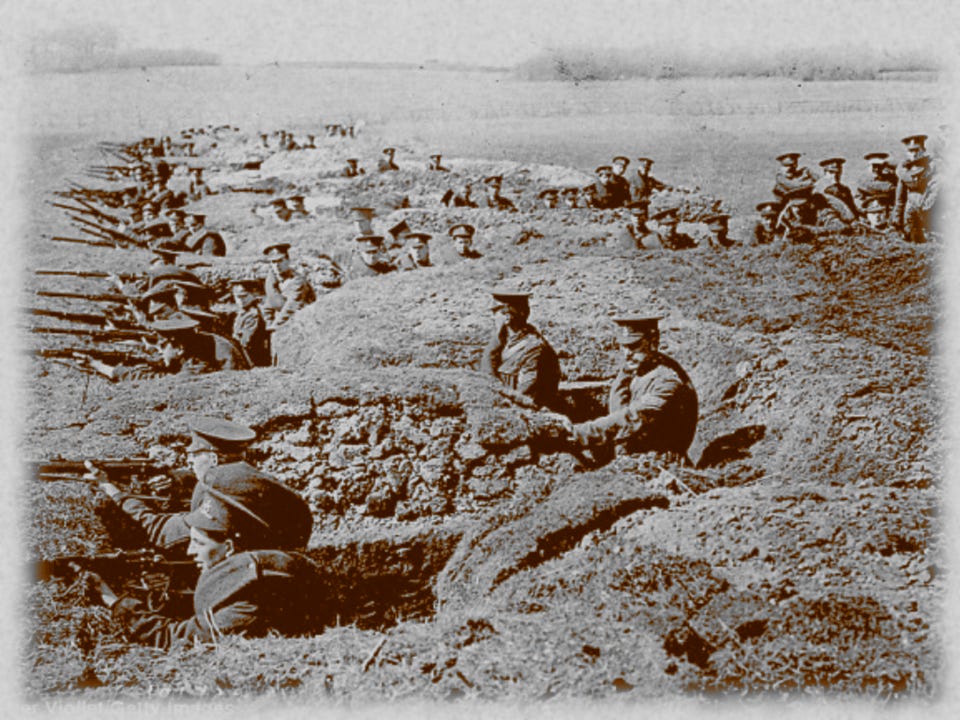
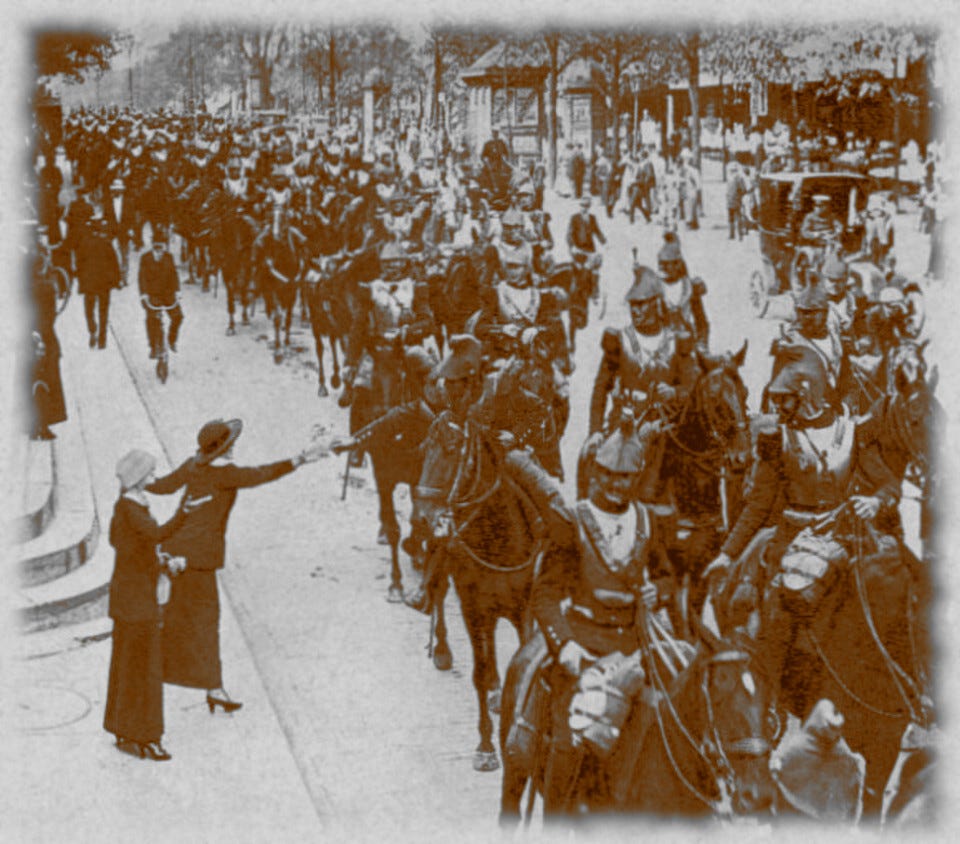
In the first fortnight of August 1914, approximately 20 million Europeans, constituting nearly ten percent of the aggregate population of the combatant states, donned military uniforms and boarded trains for their respective frontiers. Young Germans, marching toward the Belgian border, were decorated with flowers by their neighbors. By the cessation of hostilities, the original divisions that detrained in that first summer had turned over their personnel as many as three times. Thirteen percent of all European males born between 1870 and 1899 were dead, with the group from 1892–1895 suffering a reduction of nearly thirty-seven percent. These scenes of initial enthusiasm and subsequent mass slaughter resulted from a deliberate, decades-long evolution of the European state apparatus. The convergence of demographic expansion, state-directed industrial capacity, and a rigid adherence to offensive doctrine transformed the pursuit of national security into an interlocking mechanism that rendered a general European conflict both diplomatically unavoidable and demographically ruinous.
The mechanism of this transformation resided in the conversion of civilian life into military force by the general staffs of the continent. Guided by a quantitative rule that extracted two divisions of 30,000 men for every million citizens, states like Germany and Russia harnessed a population surge that saw the German Empire grow from 24 million in 1800 to 57 million by the turn of the century. This human surplus was processed through a system of universal conscription and purpose-built barracks that replaced regional identities with a uniform military literacy. When coupled to a railway network that had expanded to over 30,000 miles in Germany alone, this reservoir of manpower became a hair-trigger instrument of statecraft. The logistical requirement to mobilize millions of reservists according to precise timetables meant that a single mobilization order, such as the Czar’s signature on the morning of 30 July, effectively precluded the possibility of a diplomatic retreat, ensuring that any localized friction would escalate into a total collision of industrial societies.
The architecture of this catastrophe rests upon three pillars of nineteenth-century military development. First is the structural evolution of the division, typically comprising twelve battalions of infantry and twelve batteries of artillery, which functioned as the basic, self-sustaining unit of industrial warfare. Second is the technological primacy of the infantry assault, sustained by the mass production of magazine rifles like the Mauser 1898 and the introduction of quick-firing field guns from the Puteaux and Krupp works. Third is the social and geographic militarization effected by regular census-taking and the expansion of state-financed rail lines, which turned commercial infrastructure into an offensive tool capable of sustaining armies of unprecedented size. The interaction between these technical systems and a cultural faith in the decisive offensive provides the framework for understanding the transition from the limited engagements of the mid-nineteenth century to the attrition of the twentieth.
The Population Surge Behind Europe’s Expanding Armies
The intelligence section of the German Great General Staff operated on a clinical demographic calculus that defined the ceiling of European military power. This rule of thumb posited that every million citizens within a nation’s borders could effectively support two active divisions, or approximately 30,000 men. Between 1800 and 1900, the German population within the 1871 frontiers surged from 24 million to 57 million, providing a human reservoir that outstripped its rivals and necessitated a massive expansion of the barracks system. Austria-Hungary experienced a similar, if less industrialized, expansion, with its population rising from 24 million to 46 million despite frequent frontier adjustments and internal ethnic tensions. In contrast, the French population rose more modestly from 30 to 40 million, a growth driven primarily by increased longevity rather than a rising birthrate. This demographic divergence dictated the parameters of the arms race, forcing states to view their census rolls as inventories of potential soldiers.
The expansion of these armies was facilitated by an improvement in the physical viability of the European peasantry and urban working class. By the mid-nineteenth century, the peasant populations of Germany, France, Austria-Hungary, and Russia exhibited a marked improvement in physique, enabling national authorities to conscript a higher proportion of each annual class. In France, the combined effects of medical and dietary advances increased the size of annual contingents by an average of fifty percent over the course of the nineteenth century. Improved agricultural yields, resulting from the application of fertilizers and the use of fallow fields, were supplemented by the massive import of North American grain and refrigerated meat from Australia, New Zealand, and New Guinea. The availability of cheap sugar, tea, and coffee made grain-heavy staples more palatable, raising the caloric intake of the average conscript and producing a soldier capable of sustaining the physical demands of modern warfare.
The realization of these demographic trends occurred in the mobilization orders of August 1914, which brought over two hundred divisions into active existence across the continent. Germany, leveraging its 57 million citizens, mobilized eighty-seven infantry divisions and eleven cavalry divisions for its Western and Eastern fronts. Russia, despite lagging behind in industrial capacity, drew upon a population of 100 million to field 114 divisions and thirty-six cavalry divisions, a mass that pressured the German Great General Staff to accelerate its own mobilization timetables. France mobilized seventy-five infantry divisions and ten cavalry divisions, nearly exhausting its smaller manpower pool in the effort to achieve parity with the German 1st and 2nd Armies. These figures represented the culmination of a century where the state’s primary function became the categorization and preparation of its male citizens for the eventuality of a total clash.
The mobilization of these millions depended entirely on the transformation of the European landscape into a military instrument through the expansion of state-managed rail networks. The German rail network, which comprised a mere 291 miles in 1840, expanded to nearly 40,000 miles by 1914, with 35,000 miles under direct state management. The German government, prompted by the railway section of the Great General Staff, used state loans to finance lines in commercially unproductive regions like Bavaria and East Prussia to ensure rapid deployment toward the frontiers. These logistical arteries had already proven their decisive utility during the Prussian victories at Sadowa in 1866 and Sedan in 1870, where rail transport allowed for the concentration of force faster than the enemy could react. By 1914, the militarization of the railway meant that geography no longer acted as a buffer but as a conduit for the rapid application of industrial force.
The financial commitment required to sustain this level of preparation transformed the internal economies of the great powers. Between 1851 and 1914, the German economy expanded by nearly seventy percent, providing the industrial base necessary for the mass production of steel and armaments. This expansion was mirrored in the increasing share of national consumption directed by the state. In Britain, the government’s share rose from under five percent in the mid-Victorian era to more than seven percent by 1914, while the German government’s share rose to seven percent. This reallocation of resources funded the arsenals and fortifications that defined the modern frontier. These quantitative and logistical foundations did not remain abstract, but were embodied in the living organization of the division and the conscripted soldier, whose training and equipment reflected the doctrinal conviction that the offensive must prevail.
Forging the Citizen‑Soldier
The industrialization of soldiering began with the collection of demographic data, transforming the population of the European countryside into an inventory for the state. Regular census-taking, instituted in France in 1801 and subsequently adopted by Belgium in 1829, Germany in 1853, Austria-Hungary in 1857, and Italy in 1861, provided recruiting authorities with the specific datasets required to identify and docket every male citizen upon his reaching the age of military eligibility. This administrative revolution allowed the Prussian state, following its 1814 decree of universal service, to reach into every social class and extract manpower with a consistency that the old mercenary systems could not replicate. By 1889, the French Third Republic followed this precedent, eliminating exemptions and ensuring that the burden of service fell upon the upper crust and the laborer alike. The census served as the primary instrument of this militarization, ensuring that no potential recruit remained invisible to the district commissariats.
Once identified and inducted, the conscript entered a physical environment designed to strip away civilian autonomy and replace it with a standardized military identity. The nineteenth-century state housed these men in barracks that functioned as instruments of social control and psychological conditioning. In Germany, a conscript spent his first two years of adulthood effectively imprisoned within these structures, where his daily life was governed by distant officers and administered by senior enlisted. The individual soldier lost almost all personal responsibility, as ritual and routine dictated every working hour from reveille to lights-out. For draftees emerging from the anxieties of a rapidly urbanizing and industrializing society, this simpler, highly regulated environment offered the relief of simple obedience, effectively preparing them to function as interchangeable components within the larger machine of the division.
The military establishment further institutionalized its role by adopting the characteristics of contemporary educational institutions, testing and heightening the literacy and numeracy of recruits to meet the technical demands of modern warfare. Physical education became a central pillar of this indoctrination, heavily influenced in Prussia by the gymnastics movement of Turnvater Jahn, whose methods emphasized the development of a robust, disciplined physique through organized athletics. These ideas crossed the Rhine and were propagated in France through the specialist instructors of the Bataillon de Joinville, who promoted swimming, cross-country running, and martial arts as essential components of soldierly development. By the late nineteenth century, every leading European power except Britain had accepted the necessity of submitting its youth to this state-directed program of physical and mental molding.
Beyond physical conditioning, conscription functioned as a powerful engine of national cohesion, forging a unified identity among linguistically and culturally diverse populations. In France, the army swept up Basques, Bretons, and Savoyards, utilizing the barracks as a crucible in which regional loyalties were subordinate to a singular French identity. A similar process occurred within Germany, where the military service of Poles and Alsatians was intended to integrate these peripheral subjects into the German national fabric. Even the multi-ethnic Habsburg Empire utilized universal service to ensure that every nationality within the empire was processed through the military machine, emerging with at least a rudimentary sense of being Austrian. This deliberate transformation of the peasant into the citizen-soldier ensured that the mass armies of 1914 were not merely large collections of men, but culturally cohesive forces capable of high levels of political mobilization.
The scale of this military machine was sustained by a deep reserve that multiplied the strength of active formations many times over. In the German system, a soldier remained at the state’s disposal long after his two years of active duty, returning annually for retraining in his regiment’s reserve unit for five years. Until the age of thirty-nine, he remained enrolled in the Landwehr, and to forty-five, he was accounted for in the Landsturm, ensuring that the state could reach back decades to find trained manpower. The efficacy of this system was demonstrated by the mobilization of the 17th and 19th Reserve Divisions, which drew their personnel from the Hanseatic cities in numbers equal to their active counterparts. This layered structure allowed for a tenfold increase in mobilized strength between 1840 and 1895, creating a depth of human resources that permitted divisions to remain combat-effective even after turning over their personnel two or three times during the war’s first year. This human infrastructure was given teeth by new weapons and doctrinal faith in the offensive, which together convinced commanders that the mass conscript army could overwhelm any defense.
The Industrialization of Firepower and the Doctrinal Rise of the Offensive
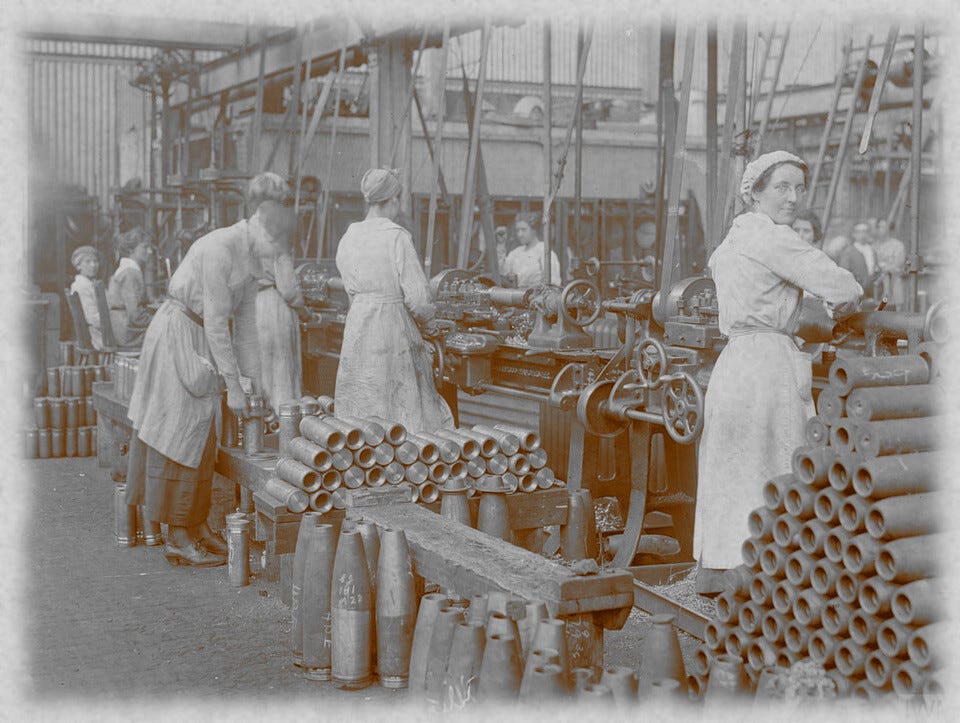
The dominance of offensive doctrine in 1914 was not a product of romantic delusion, but a rationalization of recent, overwhelming military successes achieved by the Prussian model. In the mid-nineteenth century, the armies of Prussia twice demonstrated that a force of trained conscripts and reservists, maneuvered with speed, could render traditional static defenses obsolete. During the 1866 campaign in Austrian Bohemia, Prussian formations bypassed or overran the costly fortifications intended to anchor the Habsburg defense, culminating in the decisive envelopment at Sadowa. This pattern was repeated with even greater lethality in 1870, when Prussian forces overflowed the frontier regions of French Alsace-Lorraine, trapping the Army of the Rhine within the fortress of Metz and later shattering the Army of Châlons at Sedan. These victories convinced European general staffs that the offensive, powered by rapid rail deployment and superior organizational depth, could negate any advantages offered by fixed positions or natural terrain features.
The feasibility of this offensive mandate was underpinned by a revolution in the industrial production of small arms, which transformed the infantryman into a high-volume fire platform. In 1847, the Prussian manufacturer Dreyse, operating under a state contract to re-equip the infantry, could only produce 10,000 needle-guns annually using traditional methods. However, the introduction of automatic milling machines and the principle of replaceable parts—an American innovation—fundamentally altered the scale of lethality. By 1863, the British Enfield armory had been re-tooled to turn out 100,370 rifles in a single year, while the French government re-equipped its arsenal at Puteaux with machinery capable of producing 300,000 Chassepot rifles annually. This shift ensured that by the turn of the century, every soldier in a mobilized division of 15,000 men was issued a magazine-fed weapon from a state arsenal, such as the Lee-Enfield or the Mauser 1898, capable of sustained, accurate fire.
Technological advances in ballistics and chemistry further extended the lethal reach of the infantry, expanding the kill zones of the traditional battlefield. Between 1850 and 1900, the effective range of infantry weapons increased from approximately one-hundred yards to 1,000, a tenfold expansion of the engagement envelope. This progression was a function of both precision engineering in rifling and the chemical breakthroughs of Alfred Nobel, whose development of smokeless propellants and stable bursting charges allowed for higher muzzle velocities and greater accuracy. These new propellants replaced the clouds of black powder with a clear horizon, enabling the defender to remain concealed while forcing the attacker to traverse a zone of fire that was now nearly a mile deep. Paradoxically, rather than discouraging the offensive, this increased lethality convinced commanders that only a rapid, determined assault could overwhelm an enemy before the attrition of the fire zone became unsustainable.
The industrialization of artillery followed a parallel trajectory, shifting from the era of bronze and iron to the age of machined steel. In the 1860s, the German cannon-founder Alfred Krupp began casting steel billets from which perfect, breech-loading cannon barrels could be machined with unprecedented structural integrity. These breech-loading field guns proved to be the decisive instruments of the Franco-Prussian War, providing the tactical mobility and rate of fire necessary to suppress French infantry positions and counter-battery fire. By 1897, the French application of the hydraulic recoil mechanism resulted in the Canon de 75 modèle 1897, which could fire fifteen rounds per minute without needing to be re-aimed. The integration of such quick-firing artillery pieces into the divisional structure provided the creeping barrage capability that military theorists believed would shatter any defensive line.
The most potent manifestation of this new technology was the machine gun, a weapon that mechanized the delivery of lead. Hiram Maxim, an American engineer who abandoned electrical experiments in 1883, developed the first successful fully automatic machine gun by harnessing the recoil energy of the fired cartridge to load, fire, and eject. While Maxim was famously advised to invent a device that would allow Europeans to kill each other more efficiently, the weapon was initially viewed by many European staffs as an auxiliary tool for the defense of narrow defiles or fortress gates. However, as the production of these weapons scaled, their presence in the machine gun companies of the German 1st and 2nd Armies ensured that the offensive would be met with a density of fire that no previous military era had encountered. The transition from the single-shot musket to the belt-fed Maxim gun represented a qualitative leap in the intensity of combat that far exceeded the adaptive capacity of existing tactical formations.
The willingness of the individual soldier to enter this lethal environment was sustained by a cultural transformation of military service from a burden of the marginalized to a rite of passage for the citizen. Unlike the eighteenth-century Russian serf conscript, whose departure for the army was marked by a village priest performing a requiem mass, signifying a social and often physical death, the nineteenth-century German or French soldier was a man who largely accepted his role. The young German recruit was sent to his garrison draped in flowers by his neighbors, viewing his term of service as a temporary subtraction from his liberty in exchange for social status. This enthusiasm was coupled by the manufacturing of regimental souvenirs in the tens of thousands, such as the German china drinking mugs decorated with platoon rosters. These artifacts were carried back to family homes as symbols of national belonging, reinforcing the psychological resilience required for close-order offensive tactics.
This synthesis of industrial output, chemical innovation, and social willingness created a military culture that viewed the offensive as a moral necessity. Commanders believed that the massed fire of magazine rifles and the suppressive weight of quick-firing artillery would allow the army to march across any obstacle, much as the Prussians had done in the previous generation. The division, as a self-sustaining unit of twelve infantry battalions and twelve artillery batteries, was designed specifically to project this power forward into the enemy’s heartland. When these doctrinal convictions were married to the industrialized scale of mobilization, the result was a system primed for rapid escalation and catastrophic loss.
Mobilization, Replacement, and the Arithmetic of Attrition
The interaction of demographic expansion and industrial organization crystallized in the formation of the division, the primary tactical engine of the 1914 campaigns. This organization normally comprised twelve battalions of infantry and twelve batteries of artillery, wielding 12,000 magazine rifles and seventy-two quick-firing guns. In the deployment of the German 1st Army under General Alexander von Kluck, these self-contained units were synchronized with a railway timetable that allowed no deviation without risking total logistical collapse. Because the state had invested its fiscal and administrative capital into this specific organizational structure, the mobilization of a single corps necessitated the mobilization of the entire national machine. The rigid requirement to move these massed formations toward the frontiers of Belgium and France meant that once the war by timetable began, diplomatic negotiation was superseded by the requirements of the division’s march.
The industrialization of the soldier ensured that the destruction of these formations did not lead to the cessation of hostilities, but rather to an accelerated processing of reserves. Between 1914 and 1918, the French military machine processed ten million men, a figure that represented the near-total extraction of the nation’s reproductive and productive capacity. Out of every nine men who donned French infantry blue, four became casualties of the fire zone created by Krupp steel and the rapid-fire batteries of the French 75mm guns. In the struggle for the Fort of Douaumont and the surrounding heights of Verdun, the twenty-two percent death rate among the infantry demonstrated that the industrial output of the armories had finally outpaced the endurance of the human body. The state’s ability to replace these losses through the reserve system allowed the battle to continue long after the original professional cadres had been annihilated.
The statistical outcome of this interaction was the erasure of specific demographics across the European continent. Of the 16 million males born between 1870 and 1899, thirteen percent were killed during the four years of conflict, a rate of 465,600 deaths for each year the machinery of war remained in motion. The specific cohorts of 1892–1895, who were between nineteen and twenty-two years of age during the initial maneuvers of the Schlieffen Plan and the subsequent Battle of the Frontiers, suffered a reduction of thirty-five to thirty-seven percent. These young men, who had been the primary beneficiaries of the dietary and medical advances of the late nineteenth century, were precisely the personnel whose improved physique the General Staffs had banked upon for the success of the offensive. Their systematic destruction in the face of machine-gun fire and heavy artillery revealed that the superiority sought by states was a mathematical abstraction that translated into a generational void in civilian life.
The doctrine of the offensive required a leadership class willing to expose itself to the highest risks, resulting in a disproportionate lethality among the officer corps. In the German army, where the spirit of the offensive was most deeply ingrained, twenty-three percent of all officers were killed, a figure that rose to twenty-five percent among regular officers of the pre-war establishment. This exceeded the fourteen percent death rate among German enlisted men, reflecting the tactical reality of leading massed conscript companies against entrenched positions armed with machine-guns. During the difficult crossings of the Meuse and the assaults on the Belgian fortresses at Liège, the necessity of officer-led élan meant that the very men trained to manage the military machine were the first to be consumed by it. This decapitation of the professional military class forced a greater reliance on less-trained reserves, further increasing the potential for catastrophic error and high-volume slaughter as the war progressed.
The final synergy of these developments was a military environment where the first blow was designed to be both massive and decisive, yet the system’s depth ensured it was merely the beginning of a long agony. The quest for military superiority through the expansion of the division and the rail network created a hair-trigger response where any delay invited total defeat. However, the industrialized nature of the soldier and the reserve system meant that even the destruction of two million Frenchmen, the majority being infantrymen, did not collapse the state’s will or ability to fight. Each component, the demographics, logistics, technology, and doctrine, reinforced the others to prevent a quick resolution, turning the pursuit of a decisive victory into a process of mutual exhaustion. By 1914, the great powers had built a military world in which security seemed attainable only through superiority, yet superiority itself made any conflict exponentially more destructive.
How Europe’s Military Apparatus Outran Political Control
The deliberate convergence of demographic industrialization, logistical rigidity, and a monolithic offensive doctrine effectively mechanized the escalation of conflict, converting a search for national safety into an inescapable engine of total war. The military transformation of the nineteenth century culminated in a self-perpetuating apparatus where demographic health, logistical precision, and industrial lethality combined to strip political leaders of their agency. By integrating the national census with the universal reserve system, states like Germany and France created a manpower reservoir that transformed the social fabric into a standing army, while the expansion of state-financed rail logistics ensured that this mass could be projected with irreversible velocity. This structural rigidity was validated by a doctrinal conviction, born of the Prussian experience at Sadowa and Sedan, which held that the offensive power of the army could overcome any static obstacle. Consequently, the pursuit of strategic security through quantitative and technological superiority established a hair-trigger environment where the requirements of mobilization overrode the possibilities of diplomacy, ensuring that the first tactical movement necessitated a total industrial collision.
The interaction between the physically improved conscript and the chemically enhanced weapon produced an operational environment that favored mass over maneuver. The social-military indoctrination provided the psychological resilience necessary for soldiers to endure the fire zones created by the Krupp field gun and the machine gun, yet this same resilience allowed states to absorb losses that would have shattered earlier professional armies. Because the division was designed as a self-sustaining unit capable of continuous replenishment through the Landwehr and other reserve tiers, the destruction of active formations merely triggered the next phase of the industrial processing of men. The conversion of the European landscape into a militarized grid of rail lines and barracks effectively removed the geographic and social buffers that had previously limited the scope of conflicts. Each component of the military machine, from the diet of the recruit to the hydraulic recoil of the field gun, reinforced a system that rewarded rapid mobilization and punished strategic hesitation.
The collapse of the 1914 system reveals the inherent danger in creating military instruments that possess a momentum independent of political control. When command structures are predicated on the absolute necessity of preemption and the clinical processing of millions, the margin for error disappears, leaving only a process of mutual attrition. The operational limits of the great power armies were reached not through a failure of will or a lack of resources, but through the perfection of the very demographic and industrial systems designed to ensure victory. The transformation of the individual into an interchangeable component of the division meant that warfare had ceased to be an extension of politics and had instead become a function of industrial endurance. Ultimately, the meticulous preparation of European societies for the next war ensured that the resulting conflict would possess a lethality that defied the calculations of the general staffs and exhausted the demographic foundations of the continent.
See Also


Bibliography/Further Reading
Keegan, John. The First World War. First Vintage Books Edition. Random House, 2000.
Keegan, John. The Second World War. Penguin Books, 2005.
Kershaw, Ian. To Hell and Back: Europe, 1914-1949. Penguin History of Europe 8. Viking, 2015.
Dear Sir; unless you mean the Kaiser, Franz Josef, or the Tsar no soldier started WW1.
Nor did the soldiers of France, England who were entirely subordinate to civilians who almost never served. I mention this not just as history but contemporary popular view- talking chimpanzees see uniform, think soldiers decide, throw 💩 poo at soldiers. Worse than unfair it’s the wrong culprit.
Especially in any democracy; If war is crime then the voters are the crime bosses and the soldiers just the street muscle.
As Soldier I Close with; In democracy no one is innocent, dear reader.
This is a powerful reminder that systems we build for security can take on a life of their own. What struck me most is how little room there was for human pause once mobilisation began. It makes you wonder where, in any era, we might be building structures that feel rational in isolation but become dangerous when everything moves at once.