

Red Sky at Night
The Battle's End and the High Cost of Victory

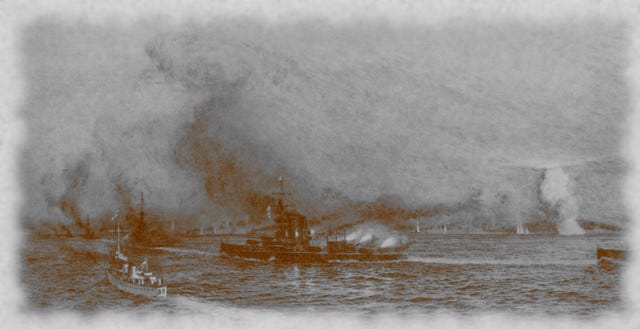
Under the cover of darkness on 31 May-01 June 1916, as the echoes of Hipper’s Death Ride faded into the North Sea, Admiral Reinhard Scheer gambled on a hazardous breakout while Admiral John Jellicoe chose restraint over pursuit. What followed was not a decisive finale but a prolonged contest shaped by darkness, doctrine, and imperfect information. In the hours after the cruiser charge and torpedo attack, Scheer’s determined escape through the night, enabled by British intelligence failures and Jellicoe’s caution, preserved the High Seas Fleet at significant cost. The result avoided German annihilation without delivering Britain the “Trafalgar” it sought, instead accelerating German reliance on unrestricted submarine warfare while confirming British command of the seas.
The Calculations Before the Collapse of Light
As twilight enveloped the North Sea, both admirals repositioned their fleets under mounting uncertainty, with Jellicoe attempting to seal off German escape routes while Scheer maneuvered urgently to avoid encirclement. Once the torpedo threat from the German destroyer attack had evaporated, Jellicoe turned his fleet back around to regain contact with the High Seas Fleet after the smokescreen had cleared. At 7:40 p.m., Jellicoe shifted his fleet to a southwesterly course. Fifteen minutes later, Commodore Goodenough signaled confirmation that the Germans were steaming west. The contact forced a reversal by Scheer, who realized he could not continue westward. He first changed course to the southwest, and then diverted south at 7:45, hoping to save the rest of his fleet by reaching the safety of friendly waters before daybreak. Dusk came after 8:00 p.m. with 143 British warships between the ninety-three German vessels trying to get to safety. Scheer would get his chance to escape.
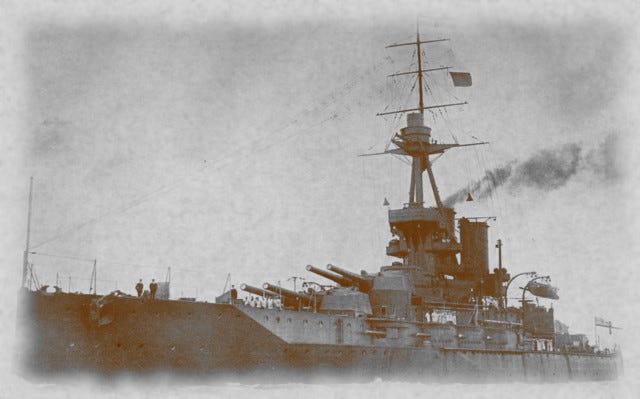
Jellicoe, out of caution, believed that night actions would expose his fleet to German destroyer attacks. He judged his destroyers ineffective in night engagements, and feared friendly fire incidents in low-visibility conditions. He thought a night battle would be left largely to chance, and therefore rejected night actions by the Grand Fleet, postponing battle renewal until morning, opening a window of opportunity for Scheer. Jellicoe understood that, despite his own losses, the High Seas Fleet had suffered heavy damage. He ascertained that the northern passage around Denmark into the Baltic was unrealistic for the Germans, given the extent of the damage, and dismissed that route as a possibility. Studying his charts aboard the Iron Duke, Jellicoe weighed Scheer’s options against the prior retreats. He reasoned the shorter route toward Horns Reef to be improbable, anticipating Scheer would make a southwesterly run to the mouth of the Ems, followed by an easterly turn behind the safety net of mines scattered around the Heligoland Bight. Based on this reasoning, Jellicoe steered the fleet south to intercept and cut off the Germans before they could reach the Bight. It was a calculated—and not unreasonable—strategy that backfired. While Jellicoe sought a dawn engagement to the south, Scheer was already driving relentlessly southeast, aiming to cut directly through the wake of the British fleet toward Horns Reef. The dusk reconfiguration blended British confidence with doctrinal restraint and German desperation, establishing conditions in which optimism, caution, and fading visibility would soon collide.
A Race to the Reef
Facing encirclement, Scheer committed to a perilous night run toward Horns Reef, while British intelligence breakdowns quietly undermined Jellicoe’s ability to intercept him. Scheer, acutely aware that a renewed engagement at dawn would likely lead to the destruction of his command, initiated his withdrawal plan at 9:10 p.m. From his flagship, the Friedrich der Grosse, he signalled the High Seas Fleet to set a course southeast by east and proceed in close order, driving straight through the lighter forces bringing up Jellicoe’s rear. He ordered the fleet to maintain course no matter the cost, and requested Zeppelin reconnaissance at daybreak. Following Scheer’s transmission, the High Seas Fleet set their course toward Horns Reef at sixteen knots. To make the dash toward the Denmark coast, Scheer had to reorder his battered ships. He positioned Friedrich der Grosse, and her undamaged sister ships Westfalen, Nassau, Rheinland, and Posen in the center, and moved the six, slow pre-dreadnoughts to the rear with Hipper’s wrecked battlecruisers. Because of the damage sustained—Lützow having taken twenty-four large-caliber shots, Seydlitz twenty-one shells and a torpedo, Derfflinger taking water, and Von der Tann combat ineffective—the reordering provided the fleet’s best chance of a breakthrough. The drive southeast to the reef was to be screened by the destroyers and their lethal torpedoes. At 9:32 p.m., the German fleet caught a break. An eagle-eyed watchman aboard the Frankfurt spotted HMS Lion signalling Princess Royal, revealing the challenge and pass signals to the German fleet. Further aiding the German breakout was bad intelligence provided to Jellicoe by Room 40. At 9:55 p.m., the Admiralty correctly informed Jellicoe that three German destroyer flotillas were preparing a night attack. However, the Admiralty was incorrect on the location, placing the German fleet ten miles to the southwest.
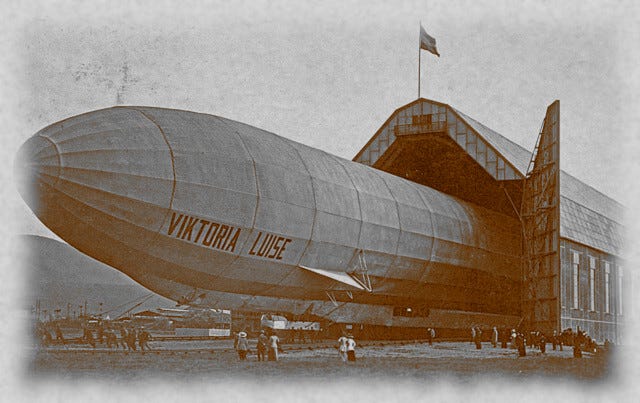
Scheer’s request for Zeppelin reconnaissance from the Denmark peninsula was also withheld, which would have provided Jellicoe with the exact nature of the route that Scheer intended to take. Further compounding the intelligence failures were seven signals intercepted between 10:43 p.m. and 1:00 a.m. that provided absolute certainty of Scheer’s route, but these were not forwarded to Jellicoe as the presiding officer had left Room 40 for the night to rest, leaving an inexperienced junior officer in charge, who saw no significance to the incoming traffic. This failure resulted in Jellicoe continuing for forty miles in the wrong direction. At 10:15 p.m., Scheer’s force met the wake of the Grand Fleet. Commodore Goodenough, on the Southampton, spotted five silhouettes to starboard a mere 800 yards away. Goodenough challenged the ships with signal lights, and after an improper response, ordered firing. Dublin opened the engagement. Upon commencement, the Germans immediately trained searchlights onto Goodenough’s cruisers and concentrated fire against Southampton, severely crippling her and leaving her decks strewn with dead and wounded. Despite the intense punishment, Southampton was able to fire off a torpedo, striking the Frauenlob, breaking her back, sending the aged cruiser to the bottom with all 320 hands. Southampton came away from the skirmish with thirty-five dead and forty-one wounded, and lost wireless telegraph capabilities that prevented informing Jellicoe of the German position. With the opportunity for interception slipping away, the battle passed from admirals and signals rooms to destroyers and lookouts, where confusion, proximity, and split-second decisions would govern the night.
Mysteries and Mayhem
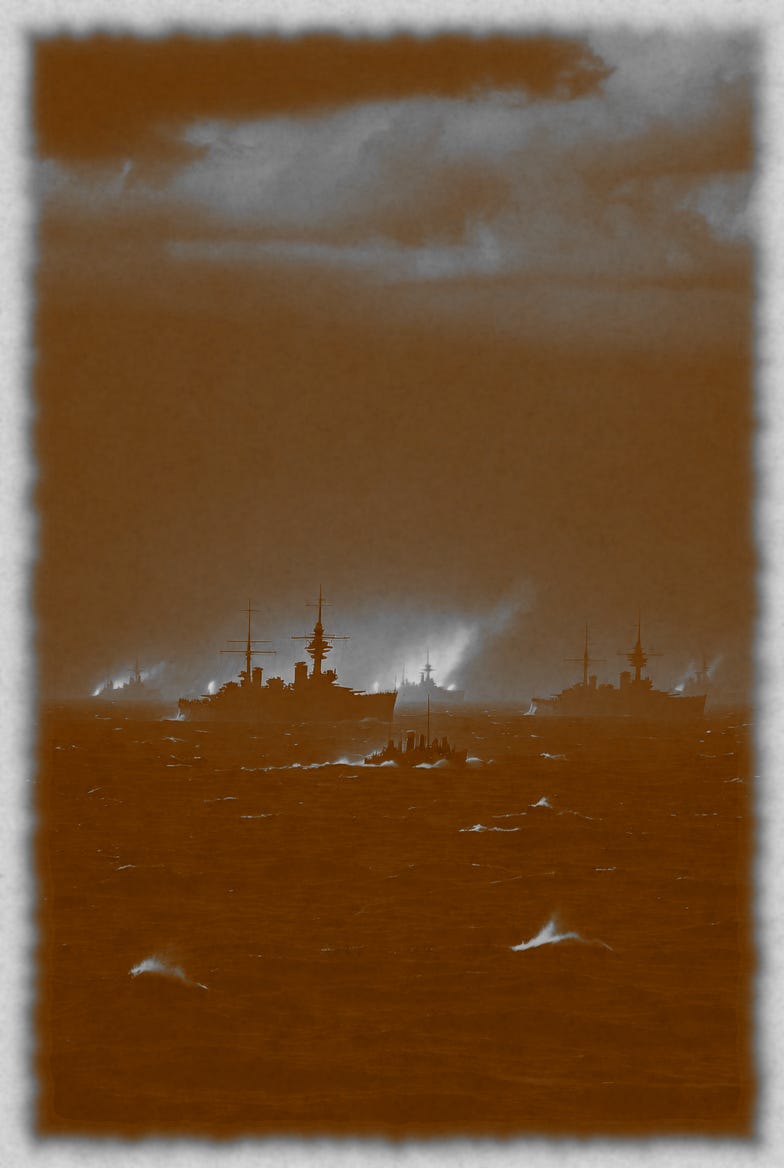
The heart of the night action beat with destroyer skirmishes, where British flotillas met German advances in blind confusion, inflicting mutual harm that underscored the perils of low-visibility combat. In the hour before midnight, in pitch black, with the two fleets not fully aware of each other’s position, the dreadnoughts of the High Seas Fleet converged on the rear of the Grand Fleet, which was screened by its destroyer flotillas. At 11:20 p.m., the 4th Flotilla spotted a series of large silhouettes approaching from starboard. Believing them to be the Queen Elizabeths, the Tipperary delayed sending the challenge lights until the massive German ships were a mere 700 yards away. Instead of the pass signal, the flotilla was met with the spotlights of the dreadnoughts Westfalen, Nassau, and Rhineland, accompanied by the light cruisers Hamburg, Rostock, and Elbing. The German ships blasted the Tipperary to atoms. Westfalen, alone, fired more than 150 shells in four minutes. The scene turned to chaos. The destroyers following Tipperary opened up with their deck guns, raking the German behemoths with 4-inch shells and firing torpedoes. The dreadnoughts and cruisers swerved madly to avoid the torpedoes, leading to a collision between Elbing and the dreadnought Posen. The monster German battleship tore the aft off the hapless cruiser, flooding the engine rooms, cutting power, and leaving the vessel adrift. The HMS Spitfire went head-to-head with Nassau, unleashing torpedoes against the iron beast. Nassau cranked engines to ahead full and turned to ram the destroyer—nearly swamping Spitfire in the collision—and fired its massive guns at the destroyer. Though the guns could not depress low enough to hit the destroyer with shells, the concussion of the muzzle burst blew the funnels, mast, and bridge off the vessel, killing all but the captain and two sailors. Despite losing the bridge and funnel, and having sixty feet of hull torn away in the collision, Spitfire was able to limp back for repairs at Newcastle-Upon-Tyne thirty-six hours later.
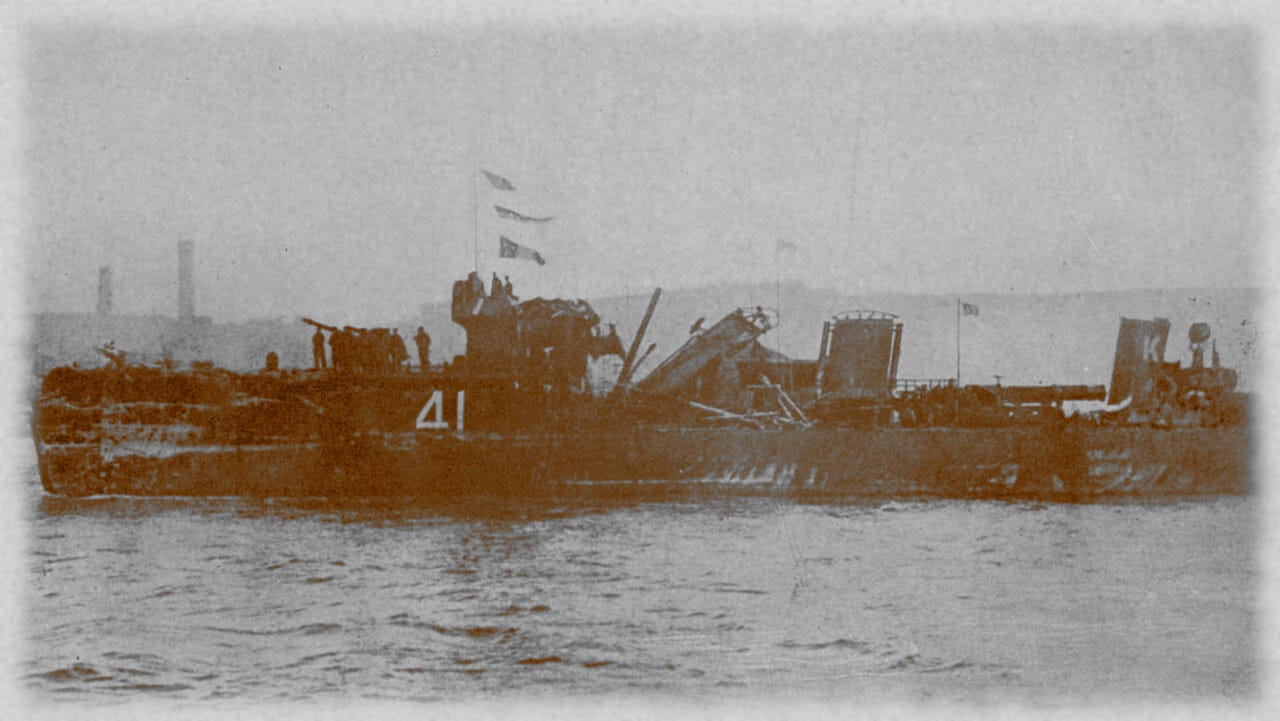
During the bedlam, HMS Broke collided with HMS Sparrowhawk while the latter was making a torpedo run, hurling twenty-three sailors from the deck of Sparrowhawk onto Broke’s forecastle. HMS Contest then emerged from the dark slicing through Sparrowhawk’s stern. The crew of Broke aided Sparrowhawk’s crew, bringing the wounded aboard before breaking free of the vessel. Contest and Broke limped into the night, leaving the broken hull of Sparrowhawk adrift in the blackened sea. The Grand Fleet’s problems didn’t end there. Shortly before midnight, the British armored cruiser, Black Prince, blundered into Scheer’s battle line. The cruiser had been part of the scattering at “Windy Corner” earlier in the evening, and lost contact with the rest of the fleet while working its way back to the south. In her attempt to link back up with the Grand Fleet, she found herself in the center of Scheer’s main dreadnought formation, The German battleships Thüringen, Ostfriesland, and Friedrich der Grosse had already sighted and correctly identified the ship as British and, unbeknownst to the Black Prince, were training their turrets upon her. At less than a mile, Black Prince flashed a challenge signal, at which point the German ships turned on their spotlights and opened fire with a salvo that took out the funnels, sending a column of orange flame one-hundred feet into the air. The cruiser passed Friedrich der Grosse close enough for Admiral Scheer to observe crew frantically running across the blazing deck. Moments later, the fire reached her magazines, and the Black Prince disappeared into a brilliant flash and explosion, killing all 900 aboard. These tumultuous exchanges, riddled with rammings and confused encounters across the midnight hours, resulted in substantial casualties.
The Last Mile
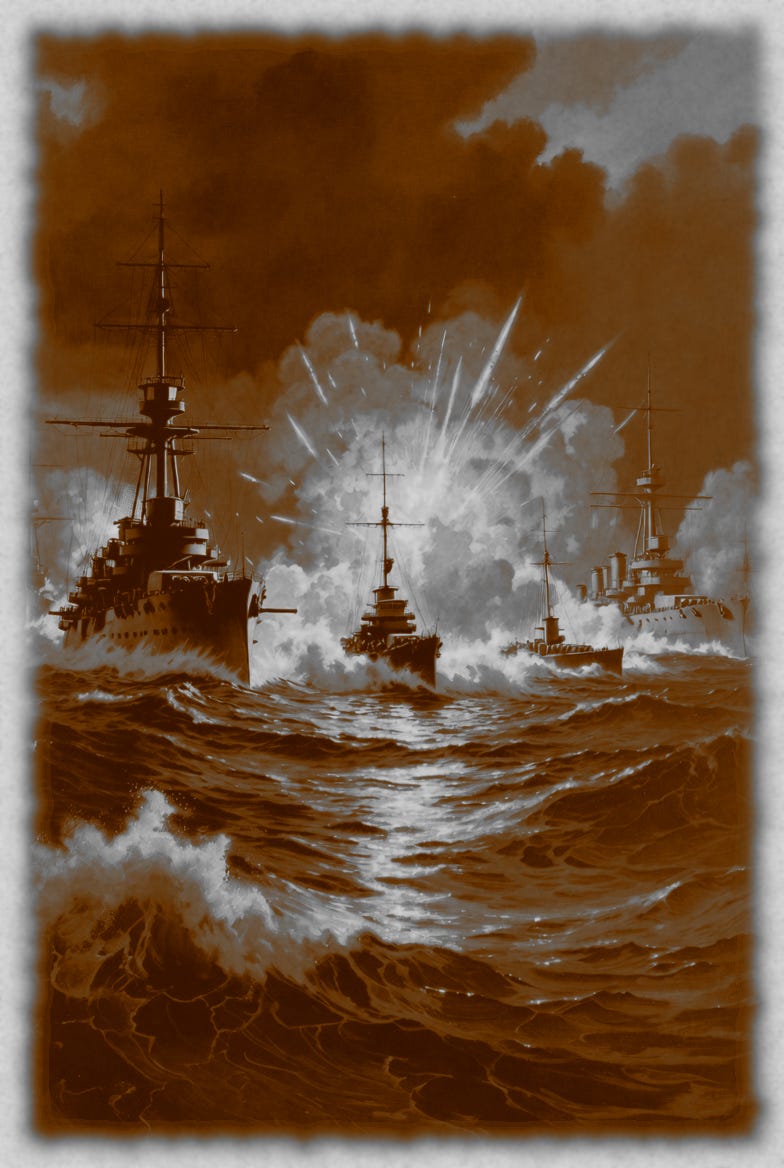
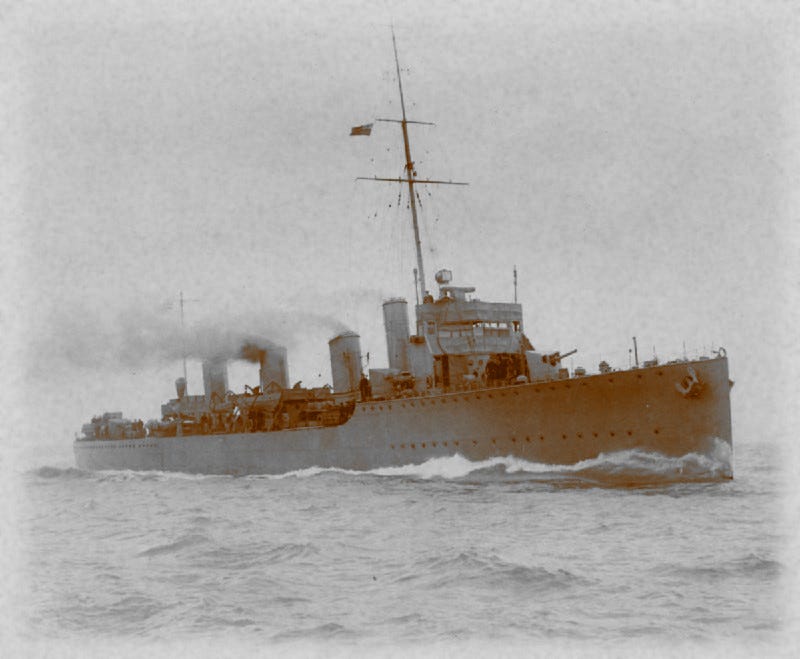
As dawn approached, maneuver gave way to outcome, and the battle was decided ship by ship rather than by fleet action. With twilight starting to creep across the horizon, the Germans would meet a disaster that matched the British. By 1:45 a.m., Scheer’s fleet had passed around the port quarter of the Grand Fleet. The only thing standing between them and Horns Reef—only twenty-eight miles ahead—was the 12th Destroyer Flotilla. Captain Anselan Stirling, aboard HMS Faulknor, sighted the ghostly line of Behncke’s massive Königs and Mauve’s pre-dreadnoughts to his starboard. Stirling flashed a challenge. Despite the Germans being aware of Britain’s correct passcode, the German fleet transmitted the incorrect pass, confirming to Captain Stirling that he was among enemy ships. Stirling telegraphed Jellicoe that he had found the main German fleet on a southeasterly course, but none of the messages found the Iron Duke. Historians debate whether it was German jamming or faulty equipment that prevented the transmission. Stirling commenced his attack, taking advantage of the hour—with enough light to nullify German spotlights, yet dark enough to complicate German gunnery—launching his first torpedoes by 2:02 a.m. In all, his six destroyers released seventeen torpedoes against the heart of the German fleet, at ranges between 2,000 and 3,000 yards.
The eels missed the primary targets—the König-class dreadnoughts—but torpedoes impacted the slower, pre-dreadnought Pommern. The impact broke the back of the old battle wagon, breaking away the bow and stern while capsizing. After bobbing for ten minutes, the two halves slipped below the sea, taking all 844 souls with her. Despite the loss, Scheer completed the breakthrough across the Grand Fleet’s wake. The German sailors, now sixteen miles from Horns Reef, were sweeping the horizon, sure to run into more British ships. Much to their surprise—and delight—the horizon was empty: no silhouettes or smoke. Before proceeding to Horns Reef, Scheer halted the fleet to wait for the wounded battlecruiser Lützow, only to receive word of her sinking. As the sun crested the horizon, Lützow was submerged up to her forward turrets, having been hit twenty-four times and filled with 8,000 tons of water. The cruiser could not reverse either, as she had settled so low that her propellers were exposed. Captain Viktor Harder signaled his destroyer screen to transfer his crew, and then ordered G-38 to fire two torpedoes to send Lützow below. His crew, watching from the destroyers, gave three cheers to the Kaiser, three cheers to Hipper and Scheer, and another three for their ship, and then sang “Deutschland, über Alles” as the cruiser sunk below the waves. Weisbaden was also lost with all but the chief stoker. The breakthrough secured German withdrawal, but the lost ships underscored the high price paid for the bold dash through the rear of the Grand Fleet.
Picking Up the Pieces
By morning, Jellicoe confronted a fragmented fleet and incomplete intelligence, forcing a cautious reassembly rather than an aggressive continuation. At 2:30 a.m., the Admiral awoke from his cot and prepared for action against his adversary, now believing Scheer to be northwest rather than south or southeast of his position. Jellicoe ordered his ships to form line astern and to turn to the north, and sent crews to their battle stations. He would also use this turn as an opportunity to collect up his scattered fleet. By 3:15, he was down a dreadnought, as Marlborough was forced to reduce speed to twelve knots due to an earlier torpedo hit and could not keep up with the rest of the fleet. An hour later, he reformed the fleet into line abreast to engage in a search pattern, seeing no signs of the High Seas Fleet, other than a minor engagement with a reconnaissance airship that resulted in nothing more than wasted ammunition. The early hours turned to mid-morning with still no sign of the enemy fleet, causing Jellicoe to devote the rest of the morning to locating and taking account of his remaining ships, identifying the missing, and recovering survivors. Among the survivors rescued from the battle debris was the captain of the Ardent, who recounted watching many sailors die in the water during the night. At 9:07 a.m., Jellicoe and Beatty exchanged signals as to the status of the fleet. It was at this time that Admiral Jellicoe—to his shock—learned the fates of Indefatigable, Invincible, and Queen Mary. With a heavy heart, Jellicoe telegraphed the Admiralty that he had finished his sweep of the battle space, unable to locate the High Seas Fleet, and reported the losses. A little after 11:00 a.m., Jellicoe gave the order to steer northwest and make the long trek back home to Scapa Flow.
Blood and Treasure
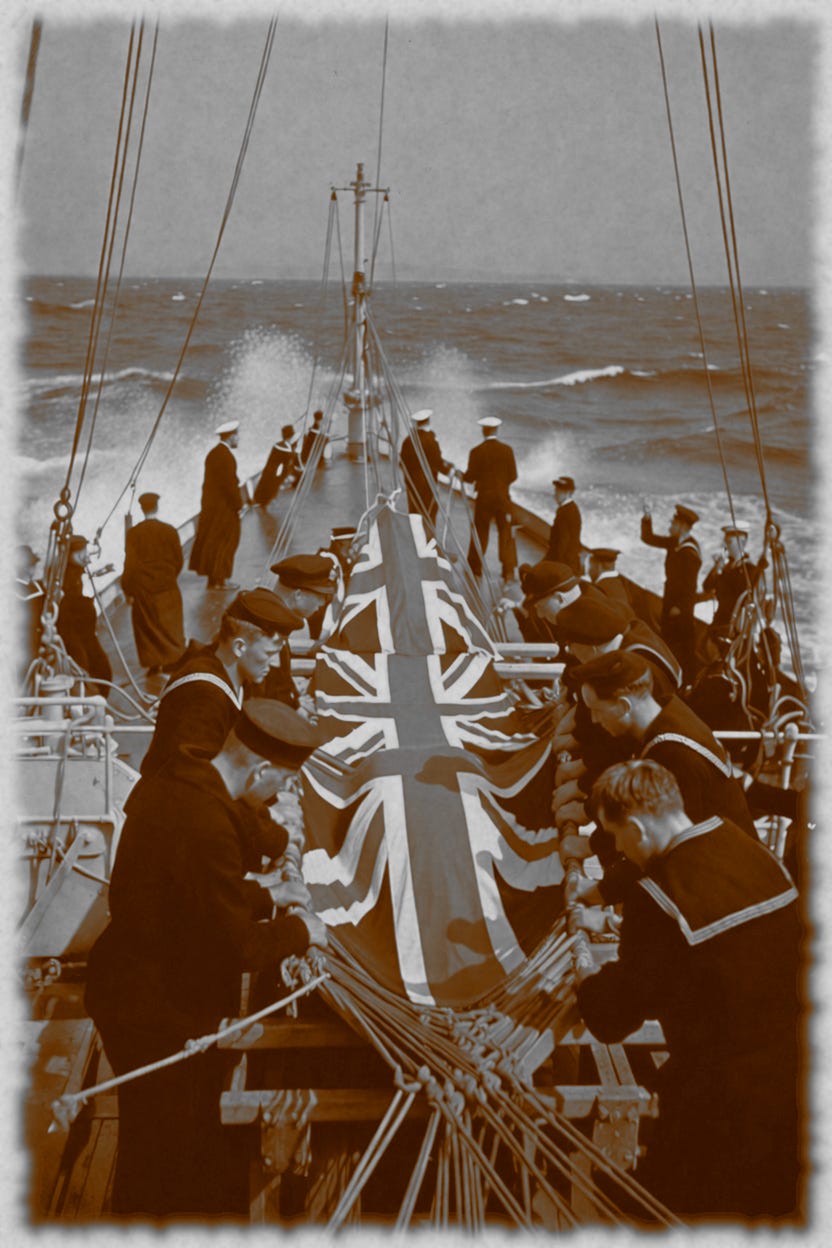
In the immediate aftermath, the human losses at Jutland translated directly into strategic, operational, and psychological consequences that reshaped how both navies interpreted the battle’s outcome. Though we often think of ships as animated iron giants, we mustn’t forget that they are merely empty shells that require the work of men to operate—sons and brothers, fathers and uncles. Each shell impact wasn’t just a hole in abstract armor plating. Behind those steel walls were flesh and blood. On the way back to port, British sailors committed their fallen to the deep. Tradition in His Majesty’s Navy required that the dead be buried at sea before a ship reached port, and throughout the journey back, sailors stitched their fallen comrades into their hammocks with a one-hundred pound shell at their feet. The canvas tombs were laid on planks and shrouded with Union Jacks. Chaplains said prayers over the fallen, bugles were sounded as the planks were raised, and the souls were laid to rest in the water. Aboard Lion, the charred remains of the mid-ship turret explosion—ninety-five in all—were committed to the deep at noon. Crews set to work cleaning the ships with disinfectant and carbolic soap. The violent explosions of the heavy shells left human remains wedged into ventilation shafts and voice pipes and had started to putrefy. Exhausted surgeons treated the wounds, noting that most cases were flash burns from exploding shells and powder, causing faces, eyelids, and lips to swell into “jellied masses.” More than 6,000 British sailors perished in the titanic clash in the North Sea—the deadliest battle in Royal Navy history. Though Admiral Scheer’s High Seas Fleet came out with fewer ships sunk, and little over 2,500 dead, it had suffered far greater damage to its surviving ships, reducing the overall strength of the Kaiserliche Marine. Kaiser Wilhelm, seeing a propaganda opportunity, claimed victory. But, if there was any victory for Germany at all, it was only tactical, and based solely on the disparity of the ships sunk and the fewer number of dead. Though it wasn’t quite the “Trafalgar” Britain had hoped for, the victory at Jutland must still be considered decisive. The High Seas Fleet was laid up for months with repairs, and later sorties never ventured much farther than coastal waters. After Jutland, the German navy relied on the U-boat flotilla to win the war at sea—an action that would draw the United States into the war and lead to Germany’s defeat. The losses did not weaken British confidence in their blockade or naval supremacy. If anything, it stiffened their resolve, while reinforcing German recognition that decisive results would have to be sought through other means.
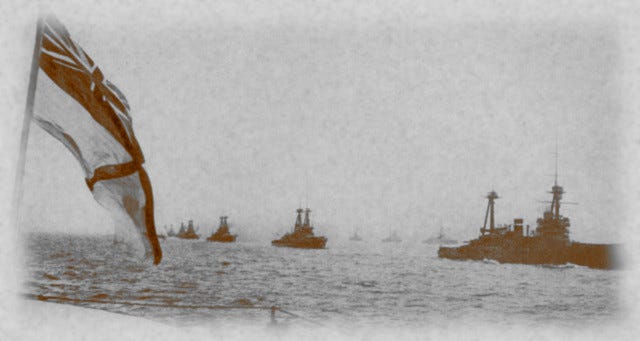
Toward the War’s Endgame
The nocturnal phase and early morning hours of Jutland revealed a battle decided less by firepower than by endurance, judgement, and the limits of control in massive naval engagements. Scheer’s audacious passage through darkness preserved his fleet but inflicted losses that deepened material strain, hastening Germany’s turn toward submarines and its eventual downfall. Jellicoe’s caution, though denying total annihilation of his adversary, still produced a decisive victory and safeguarded Britain’s dominance of the oceans, while simultaneously upholding the blockade that was slowly strangling Germany, adding to its desperation. Ultimately, Jutland proved that victory in industrial warfare was not found in a single, glorious moment of destruction, but in the grinding endurance of the men, and their machines, who held the line. In the end, survival—not spectacle—defined the outcome. And while the admirals claimed their strategic triumph, the true weight of that victory remained settled in the cold, quiet depths of the North Sea, where the fleet’s sons and brothers keep watch in eternal vigilance.
See Also


Further Reading
Keegan, John. The First World War. First Vintage Books Edition. Random House, 2000.
Massie, Robert K. Castles of Steel: Britain, Germany, and the Winning of the Great War at Sea. Random House Publishing Group, 2003.
Meyer, Gerald J. A Aorld Undone: The Story of the Great War, 1914 to 1918. Paperback. Delta History. Delta Trade Paperbacks, 2007.
Superb detail in this article, nice blend of Tactical, Operational and Strategic levels