

Why I Write

The discipline of military history remains one of the most essential, yet frequently maligned, pursuits in the human experience. Popular enthusiasm often reduces the study of war to a sterile preoccupation with maps or a fascination with the instruments of destruction. This perspective misses the fundamental truth that conflict is the primary driver of historical change, and the ultimate test of human character. To study the history of warfare is to study the mechanisms of survival and the fragility of the social order. It is an inquiry into the very nature of human behavior at the point of maximum stress. For the military history enthusiast, the battlefield serves as a laboratory where the thin veneer of civilization is stripped away to reveal the core of the individual and the collective will of a people.
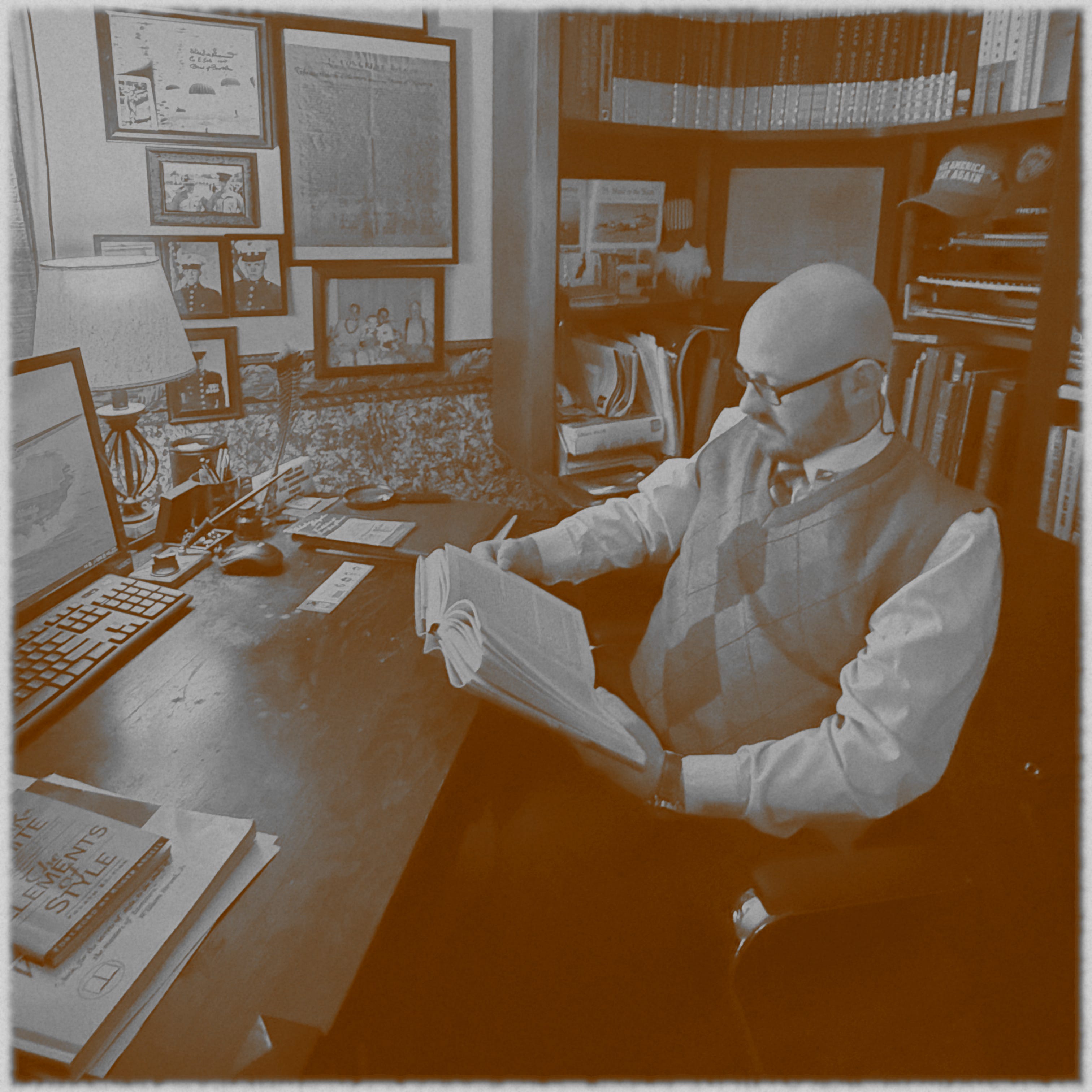
My own entry into this field was a process of gradual immersion, rather than a sudden realization. It began with the inherited memories of a military family and matured through the practical realities of service in the United States Marine Corps. These experiences provided a visceral context for the theoretical frameworks I would later encounter as I continued to hone my thought process. My approach to the subject is rooted in the belief that while grand forces and social movements provide the stage for history, it is the exceptional individual who directs the drama at the decisive moment. This essay serves as an examination of that intellectual development and the specific influences that shaped my understanding of the past.
I will explore how family stories first sparked a love for the subject, and how my time in the Marine Corps transformed that interest into a professional calling. Furthermore, I will discuss the evolution of my theoretical thinking as I moved from the rigid principles of military doctrine to the more nuanced realities of Clausewitzian friction. The goal is to provide a comprehensive look at the formation of how I think about the past, and the specific philosophy that guides my writing and research today. I believe that the study of the past is a necessary tool for understanding the present and preparing for the challenges that lie ahead. By analyzing the intersection of the man and the hour, we gain a deeper insight into the forces that have shaped our world.
History is not a series of inevitable occurrences or a collection of random accidents. Instead, it is a complex tapestry where the broad movements of society meet the singular and decisive will of the individual. This inquiry is far more than a mere reflection on past events. It is an exploration of how the lived experience of combat and the rigorous study of theory combine to create a coherent philosophy of war. I believe that the study of military history is essentially the study of humanity itself in its most desperate and revealing moments. It tends to seem somewhat paradoxical, as war brings out both the best and worst of man.The following sections will trace this development from the formative years of my youth to the analytical rigor of my current professional work. This is an attempt to define the origins of my thought and the purpose of my labor.
Inheritance
I currently reside in my hometown in Kansas with my beautiful wife and our youngest daughter. Three of our children are now off and on their own, sadly. My life is defined by the responsibilities of a husband and a father of four children. While my daily existence is rooted in the quiet landscape of the Great Plains, my intellectual and professional pursuits are inextricably linked to a deep and abiding interest in the history of conflict. This interest did not emerge in a vacuum. It was the product of a specific environment where military service was viewed as a natural and noble calling. My family history is a microcosm of the American military experience. This lineage served as the primary catalyst for my development as a writer and a historian. The values of the Heartland often emphasize tradition and continuity. These themes are central to the study of the past.
The foundation of this heritage began with my grandfather. He entered the United States Marine Corps on 29 July 1943. His entry into the service was marked by a youthful urgency that defined much of the generation that fought the Second World War. He initially sought to abandon his high school education to enlist during the height of the conflict. However, his teacher intervened and convinced him to complete his education before enlisting. This was only a short delay. By the time he reached the Pacific theater, the war had entered its most brutal and decisive phase. He served until 4 April 1946. While he initially aspired to serve as a tailgunner in a Douglas SBD Dauntless dive bomber, the physical realities of motion sickness intervened. He adapted to the needs of the Corps and became a radio operator. He achieved the rank of corporal. His service included the campaign for Guam. The liberation of that island was a significant tactical achievement in the Marianas. The stories of his time in the Pacific provided my first introduction to the logistical and human costs of amphibious warfare. His transition from an aspiring aviator to a ground combatant highlighted the friction that often dictates a military career.
The tradition continued through the next generation of my family. My uncle served in the Marine Corps from 1973 to 2000. His career spanned the difficult years of the post-Vietnam era and the eventual revitalization of the military during the 1980s. He rose to the rank of Sergeant Major. He spent much of his career as a helicopter mechanic, and served abroad on multiple WESTPAC deployments. His technical proficiency eventually led him to a prestigious assignment with Marine One. He served the presidential flight detachment during the administrations of Jimmy Carter and Ronald Reagan. This exposure to the highest levels of the executive branch provided a different perspective on the intersection of military service and national policy. He witnessed the transition from the malaise of the late seventies to the assertive foreign policy of the Cold War. His long tenure represented the institutional memory of the Corps.
However, it was my father who served as the most immediate inspiration for my own eventual enlistment. He served from 1977 to 1981. Like my grandfather, he attained the rank of corporal. He worked in motor transport. His descriptions of the daily grind and the camaraderie of the enlisted ranks made the prospect of becoming a Marine feel like a necessary rite of passage. He represented the practical side of the military. He understood the vital importance of the supply chain and the movement of men and material. While the infantry captures the imagination, the motor transport units provide the mobility required for modern operations. My father embodied the quiet professionalism that is the hallmark of the Marine Corps.
Family gatherings were rarely casual social events in the traditional sense. When the veterans of the family congregated for holidays or special occasions, the conversation inevitably turned toward their shared experiences. I spent my formative years as a silent observer to these oral histories. These men did not speak of abstract heroism. They spoke of the mechanical failures of equipment and the peculiarities of their commanding officers. They recalled the specific humidity of the Pacific and the routines of the motor pool. These narratives humanized the titanic struggles I would later read about in textbooks. They bridged the gap between the monumental events of world history and the individual lives of the men who executed the orders. I realized early that history was a living thing. It could be passed down through the generations like an heirloom. These stories formed the bedrock of my understanding of the warrior’s experience. I am proud to say that our son has chosen to follow in these footsteps, and serve in the United States Marine Corps, continuing the ‘family business,’ so to speak.
My intellectual curiosity soon moved beyond the dinner table. While my peers were occupied with the standard literary fare of primary school, I was drawn to the historical record. I remember the contrast between the books on the desks of my classmates and those in my own hands. My fellow students read stories like Where the Red Fern Grows or The Indian in the Cupboard. I was immersed in the operational details of the European theater. I sought out books on the D-Day landings, fighter aces of the world wars, and operations. These books provided a structural understanding of the war that went beyond the anecdotes of my family. They introduced me to the concepts of air superiority and logistical build-up. They taught me that the outcome of a battle depended as much on the preparation of the pilot as it did on the courage of the infantryman. I began to see war as a complex system, rather than a series of disconnected events.
The story of D-Day was particularly influential. It broke down the massive invasion into its constituent parts. It explained the roles of the paratroopers, engineers, intelligence officers, and the sailors. It showed how a singular objective required the synchronized effort of millions. The Second World War aerial warfare books served a similar purpose. It highlighted the individual skill and technical mastery required to dominate the skies. These books did more than teach me facts. They taught me how to think about history. They encouraged me to look for the cause and effect in every engagement. I began to understand that victory was often a matter of superior organization and the correct application of force. This was the beginning of my journey toward a professional understanding of military affairs.
This early exposure established a lifelong habit of rigorous study. The love of military history and the discipline of reading took root in that fertile soil. I developed a preference for the physical page over that of the screen. This habit has persisted into my adult life. I still dedicate at least three hours every day to uninterrupted reading. I avoid the distractions of modern technology to focus entirely on the text. This commitment to deep study allows for immersive reading and offers the opportunity to reflect on what I have read. It is a discipline that I trace directly back to those early years. The intersection of family lore and immersive study created a foundation that would eventually sustain me during my own time in the service. My early life was a preparation for the challenges that awaited me in the Marine Corps and the work that would follow. The transition from a consumer of history to a participant in it was the next logical step in my development.
From Observer to Participant
The transition from the curiosities of youth to the functional realities of the infantryman began while I was still a student in high school. My decision to enlist in the United States Marine Corps was a deliberate act of continuity. It was the logical conclusion of a childhood spent immersed in the traditions of my family and the literature of the Second World War. I graduated from high school on 22 May 2005. Less than a month later, on 19 June 2005, I arrived at Marine Corps Recruit Depot San Diego. The geographic shift from the plains of Kansas to the coastal confines of the depot represented more than a change in scenery. It was the beginning of a systematic process designed to replace civilian individualism with a collective military identity. The training at San Diego is a study in the psychological and physical reshaping of the human will. It is the foundation upon which the entire structure of the Marine Corps rests.
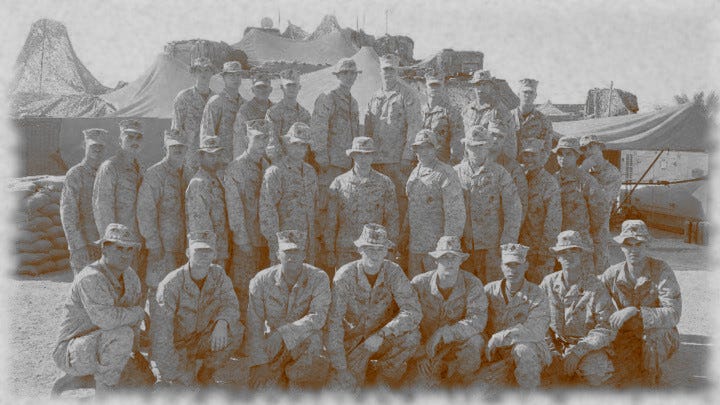
Following the completion of recruit training, I proceeded to the School of Infantry at Camp Pendleton. This phase of instruction moved beyond the basic discipline of the drill field and into the technical requirements of the rifleman. It is here that one begins to understand the mechanical nature of small unit tactics. The training emphasized the importance of the fire team and the squad as the essential building blocks of combat power. My service from 2005 to 2009 took place during a period of intense operational commitment for the United States. During these four years, I completed three combat deployments to Iraq with the legendary First Battalion, Seventh Marines. The conflict in Iraq provided a stark contrast to the historical narratives of my youth. It was a war defined by the complexities of counterinsurgency operations, and the persistent friction of urban warfare. The experience of the individual infantryman in this environment is often characterized by long periods of the mundane, interrupted by moments of extreme violence. This reality served as a secondary education in the nature of human conflict.
While the physical demands of service were significant, my intellectual development continued in the gaps between operations. It was during this time that I discovered the Commandant’s Reading List. This resource is a curated collection of literature designed to foster professional military education across all ranks. For a young Marine with a preexisting passion for history, it served as a roadmap for advanced study. I began to spend my limited down time in the pursuit of strategic and tactical knowledge. I purchased works that would become the cornerstones of my library. Barbara Tuchman and her masterpiece, The Guns of August, provided a profound look at the failure of diplomatic and military planning during the opening weeks of the First World War. Her analysis of how rigid mobilization schedules and individual personalities can drive a continent toward catastrophe was a revelation. It reinforced the idea that history is often the result of human error and the inability to adapt to changing circumstances.
I also turned to the foundational texts of the Marine Corps itself. The Small Wars Manual is perhaps the most significant doctrinal publication in the history of the service. Although it was originally compiled from the experiences of the Banana Wars in Central America and the Caribbean, its lessons remained remarkably relevant to the situation in Iraq. It provided a framework for understanding the political and social dimensions of an insurgency. It taught me that military force is often a blunt instrument that requires careful application to achieve lasting stability. I supplemented these doctrinal studies with personal memoirs of leadership and combat. Bayonet! Forward by Joshua Lawrence Chamberlain offered a perspective on the moral courage required to lead men in the most desperate of circumstances. Chamberlain was a scholar who became a soldier. His transition mirrored my own aspirations to bridge the gap between the world of ideas and the world of action. Others along this stretch included With the Old Breed, Islands of the Damned, among other Marine Corps memoirs from the Pacific Campaign.
Reading works like these while in a combat zone created a unique synthesis of theory and practice. The concepts I encountered in the pages of Tuchman or the Small Wars Manual were not abstract theories. They were descriptions of the very systems I was observing on the ground. Being in a combat environment influenced the way I look at war in a way that no classroom could replicate. I began to understand war as a series of interconnected systems. These systems include the logistical lines that sustain a force and the communications networks that relay orders. They also include the psychological state of the troops and the cultural landscape of the civilian population. I realized that a failure in any one of these areas could lead to the collapse of the entire effort.
The perspective, when studying history, is often detached and retrospective. However, the perspective of the participant is immediate and visceral. My time in Iraq allowed me to view military history through the lens of the individual who must execute the strategy. I saw how a well conceived plan could be unraveled by a single broken vehicle or a misunderstood radio transmission. This understanding of friction is central to the Clausewitzian view of war. It is a concept that I would later explore in greater depth during my academic studies. My service provided the context for the history I had read as a child. It transformed my interest from a fascination with the drama of battle into a serious inquiry into the mechanics of warfare.
The three deployments to Iraq served as a laboratory for the study of human behavior. I observed how different individuals responded to the stress of combat and the boredom of the occupation. I saw the impact of leadership at the lowest levels and how a single corporal or sergeant could influence the outcome of a patrol. These observations reinforced my belief in the importance of the individual in history. The grand strategies discussed in Washington or Baghdad eventually had to be implemented by young men on the streets of Ubaydi. There is a profound gap between the intentions of the commander and the actions of the subordinate. Bridging that gap is the primary challenge of military leadership and the central theme of much of military history.
By the time I left the Marine Corps in 2009, my commitment to the study of history was absolute. The combination of family heritage and personal experience had created a foundation that was both broad and deep. I had seen and studied the theories that attempted to explain it. I recognized that my education was only beginning. The transition back to civilian life offered the opportunity to pursue a more formal academic path. I carried with me the lessons of the infantry and the books that had sustained me during my service. I understood that to truly comprehend the past, one must be willing to engage with both the grand narratives and the minute details of martial life. My time in the Marines was not a detour from my historical pursuits. It was the essential preparation for a life dedicated to the analysis of war. The discipline and perspective I gained during those years continue to inform every word I write today. The study of military history is not merely an academic exercise. It is a means of honoring the experiences of those who served and a way to ensure that their lessons are not forgotten.