

Chickamauga and Chattanooga
Command Dysfunction, Operational Friction, and the Opening of the Deep South

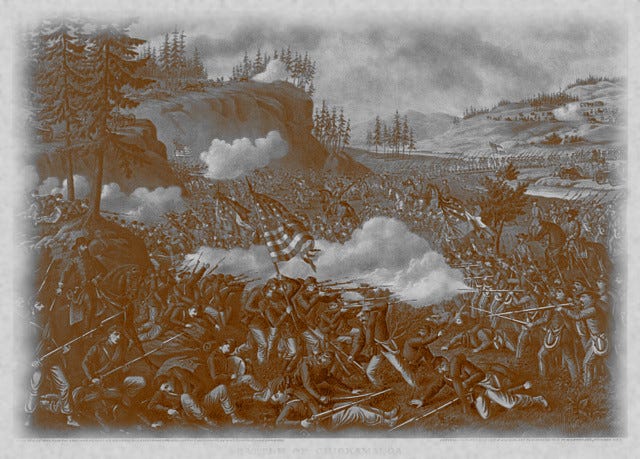
The struggle for the gateway to the Deep South, in the autumn of 1863, stands as a profound study in the divergence of tactical performance and strategic reality. During these pivotal months, the tangled forests and formidable mountain ranges of northern Georgia and eastern Tennessee became the theater for a campaign that would decide the fate of the Confederate heartland. This was a conflict defined by the iron logic of logistics, and the often irrational behavior of men in high command. The operations around Chickamauga and Chattanooga represent a critical sequence where the traditional metrics of victory and defeat were reversed by the pressures of organizational endurance and political will. In the American Civil War, the sheer scale of the landscape often swallowed the intentions of the commanders, and this campaign illustrates the friction that exists between a general’s map and the rugged terrain of reality.
The campaign emerged from a landscape that dictated the movement of masses with an unforgiving hand. To understand the movements of the Army of the Cumberland and the Army of Tennessee, one must first recognize that the Appalachian barrier and the Tennessee River acted as the primary protagonists. Control of these features was a matter of survival. Chattanooga served as the vital nexus of the rail lines that fed the Confederate war effort, and its loss would sever the logistical connection between the eastern and western theaters of the rebellion. This strategic urgency compelled the Union forces under William S. Rosecrans to push southward with a speed that often outpaced their ability to secure their own rear. At the same time, the Confederate forces under Braxton Bragg were forced into a reactive posture that strained the limits of their internal cohesion.
The subsequent battles unfolded as a chain of operational movements shaped by profound miscommunication and the exploitation of fleeting opportunities. The initial Confederate tactical success at the Battle of Chickamauga represents one of the most significant moments of Southern arms during the entire war. However, this triumph failed to yield a decisive strategic result. The failure did not stem from a lack of courage among the rank and file, but rather from a systemic collapse of the Confederate command structure. Strategic hesitation and deep-seated animosity among the Southern generals allowed a battered Union army to survive. The victory was hollow because the institution of the Army of Tennessee was too fractured to pursue its advantage to the point of total destruction.
Conversely, the Union experience in this campaign provides a remarkable example of organizational recovery and the power of unified command. Following the near-disaster at Chickamauga, the North did not collapse into a state of paralysis. Instead, the Union war machine initiated a massive reorganization and a logistical feat of breathtaking proportions. The arrival of Ulysses S. Grant, and the subsequent coordinated offensives, transformed a besieged and starving garrison into an aggressive force of invasion. This recovery reveals the fundamental strength of the Union military infrastructure which could absorb a tactical defeat and yet maintain the strategic initiative.
Ultimately, the transition from the bloody fields of Chickamauga to the dramatic heights of Missionary Ridge demonstrates that the outcome of a campaign is often determined far from the point of bayonet contact. It is determined in the corridors of power, in the supply depots, and in the minds of commanders who must manage the psychological weight of thousands of lives. The Chickamauga Campaign, and the subsequent Battle of Chattanooga, revealed the fragile relationship between winning a fight and winning a war. As the Confederate tactical success dissolved into a catastrophe at Chattanooga, the path was cleared for the eventual invasion of the Deep South. This sequence of events fundamentally altered the trajectory of the American Civil War by proving that tactical victory without strategic follow-through is merely a delay of the inevitable. The campaign stands as a testament to the fact that in modern warfare, the ability to reorganize and resupply is just as critical as the ability to charge an enemy line. Through this lens, we see how a campaign that began in the mountain gaps ended by opening the gates to the very heart of the Confederacy.
The Maneuver War Before the Storm
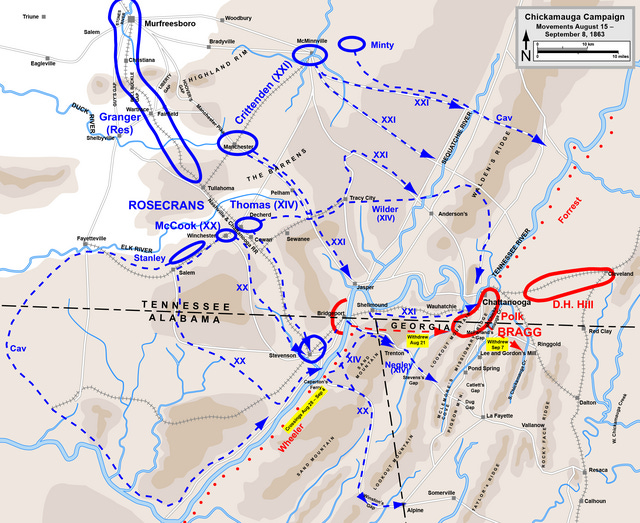
The strategic environment of the American Civil War underwent a fundamental shift following the dual Union victories at Vicksburg and Gettysburg during the summer of 1863. These triumphs provided the Federal government with a rare moment of operational momentum. In the aftermath of these successes, Abraham Lincoln recognized a unique window of opportunity. He urged William S. Rosecrans to press his advantage against an enemy that appeared to be off balance and reeling from the weight of recent losses. The president understood that the psychological impact of another major Confederate defeat in the West might well break the back of the rebellion. For Lincoln, the objective was not merely the defeat of an army, but the seizure of Chattanooga. This city functioned as a vital rail and logistical hub that linked the eastern and western theaters of the Confederacy. Its capture would effectively sever the interior lines of the South and leave the Deep South vulnerable to a direct invasion.
Rosecrans responded to these pressures with a display of operational brilliance that is often overshadowed by the carnage that followed. In late June and early July, the Army of the Cumberland embarked on the Tullahoma Campaign. This movement was a masterpiece of maneuver and deception. Rosecrans did not seek a direct and bloody confrontation with the entrenched forces of Braxton Bragg. Instead, he utilized the rugged terrain to his advantage. Four northern infantry corps and one cavalry corps burst through different gaps in the Cumberland foothills south of Murfreesboro. By spreading his forces, Rosecrans confused Bragg with a series of sophisticated feints. The Union commander managed to place strong forces on both Confederate flanks in the Duck River Valley. This maneuver forced Bragg to realize that his positions were untenable. The technological superiority of the North also made a terrifying appearance during this phase. One Union brigade of mounted infantry, armed with seven-shot Spencer carbines, penetrated deep into the rebel rear. These soldiers threatened to cut the rail lifeline that sustained the Confederate army. The speed and firepower of this unit illustrated the changing nature of the conflict.
The pressure of the Union advance compelled a rapid Confederate retreat. Braxton Bragg withdrew his forces over the rain-swollen Tennessee River on 6 July. He fell back toward Tullahoma in a desperate bid to defend his supply lines. However, the relentless pace of the Union maneuver eventually forced him to abandon eastern Tennessee entirely. Bragg returned to the fortifications of Chattanooga and prepared to defend that key city. The loss of the surrounding territory was a significant blow to Confederate prestige and logistics. At the same time, the Union offensive expanded into other sectors. Ambrose E. Burnside, commanding the Department of the Ohio, penetrated the Cumberland Gap and drove the Confederates from the region around Knoxville. This secondary advance further isolated the Army of Tennessee. When Burnside rode into Knoxville on 3 September, he was met with the cheers of a population that had remained largely loyal to the Union. The loss of Knoxville meant that the Confederacy had lost control of one of its most important agricultural and mineral regions.
Despite these setbacks, the Confederate leadership was not yet ready to concede the theater. Braxton Bragg realized that his army was being pulled apart by the divergent Union columns. He decided to exploit the very mountain gaps that Rosecrans was using to invade Georgia. Bragg sought to regain the initiative through a daring campaign of deception by sending false deserters into the Union lines. These men carried carefully crafted tales of a Confederate army in full retreat and total disarray. Bragg hoped to lure the three separated columns of the Army of the Cumberland through the mountains. His plan was to pounce on these isolated fragments individually in the valley south of Chattanooga before they could concentrate for a general battle. It was a classic Napoleonic strategy of using interior lines to defeat a superior force in detail.
However, the execution of this plan revealed the deep institutional rot within the Confederate command structure. The relationship between Bragg and his subordinates was characterized by mutual distrust and open hostility. This friction had disastrous consequences during the critical days of mid-September. Three times from 10 to 13 September, Braxton Bragg ordered attacks by two or more divisions against outnumbered and isolated fragments of the enemy. Each time, a golden opportunity to destroy a portion of the Union army was lost. The generals assigned to make these attacks frequently considered their orders to be discretionary, and found various reasons for not moving forward. In some cases, they claimed that the enemy was stronger than reported, while in others they simply failed to coordinate with neighboring units. These failures were the result of a breakdown in professional discipline and military hierarchy. Bragg possessed the vision to see the opening, but he lacked the leadership capital to force his subordinates to exploit it.
The operational pause caused by these failed attacks allowed Rosecrans to begin the frantic process of re-concentrating his scattered corps. The Union commander finally grasped that Bragg was not in retreat, but was instead looking for a fight. The maneuver phase of the campaign reached its conclusion as the two massive armies began to coalesce in the valley of the Chickamauga. The terrain here was a nightmare for military commanders. It consisted of dense forests, thick undergrowth, and a limited network of narrow roads that made the movement of large bodies of troops nearly impossible to track. The clean lines of the campaign map were replaced by the confusing reality of the woods. As both armies converged in the dense terrain around Chickamauga Creek, early maneuver gave way to collision, where confusion and command friction would determine the battle’s outcome.
A Battle Lost in the Woods
The Battle of Chickamauga provides a stark illustration of how the physical environment can strip a military organization of its cohesion and reduce a grand operational plan to a series of disconnected and bloody collisions. In the dense timber and thick undergrowth west of Chickamauga Creek, the traditional hierarchies of command were frequently rendered useless by the lack of visibility. On the morning of 19 September, the engagement began almost by accident when enemy patrols encountered one another in the tangled landscape. This initial contact rapidly escalated as both commanders fed more men into the fray without a clear understanding of the enemy’s full strength or disposition. What followed was a struggle characterized by a degree of tactical confusion that has few parallels in the American Civil War. The soldiers found themselves fighting in a “green hell,” where the smoke of black powder settled into the stagnant air of the forest and obscured the very lines of battle they were desperately trying to maintain.
Braxton Bragg entered the engagement with a specific operational fixation. He intended to turn the Union left flank to seize the roads leading back to Chattanooga and pin the Army of the Cumberland against the mountain walls. Throughout the first day, Bragg launched savage attacks by entire divisions against the Union corps commanded by George H. Thomas. These assaults were not the graceful maneuvers of the parade ground, but were, instead, grinding pushes through brush so thick that officers could often see only a few dozen of their men at a time. Rosecrans responded by shifting units from his center and right to bolster Thomas’s position. This process of constant reinforcement came at a harsh cost in lives and physical exhaustion for both sides. By the end of the first day, the battle remained a series of brutal stalemates along a shifting and poorly defined front.
The arrival of darkness did not bring true rest for the troops. George H. Thomas recognized the precarious nature of his left wing and spent the night of 19 September supervising a forced march to strengthen his lines. His men labored in the gloom to construct breastworks of felled timber and earth. When the sun rose on 20 September, the Union left was a formidable defensive barrier. On the Confederate side, the morning was marked by the same command dysfunction that had plagued Bragg throughout the campaign. Leonidas Polk, tasked with opening the second day of the attack at dawn, failed to move his troops until several hours after the appointed time. This delay allowed the Union defenders to further improve their positions and catch their breath. When the Confederate assault finally began, it made little headway against Thomas’s stubborn infantry who fired from behind their overnight fortifications. The Confederate echelon attack, which was designed to roll up the Union line from north to south, began to fall apart under the pressure of poor timing and heavy casualties.
Frustrated by the lack of progress on the right, Bragg took the gamble of canceling the echelon order. He turned to James Longstreet, who had recently arrived from the Army of Northern Virginia with veteran reinforcements. Bragg ordered Longstreet to go forward with everything he had. At approximately 11:30 a.m., Longstreet launched a massive assault with four divisions arranged in a deep column formation. This concentration of force was intended to punch a hole through the Union center and right. The tactical brilliance of this move was amplified by a catastrophic Union error. William S. Rosecrans received a faulty staff report indicating that a gap had opened in his line. In a state of nervous agitation, Rosecrans ordered Brigadier General Thomas J. Wood to move his division out of the line to close this nonexistent gap. The resulting movement created a real and massive void in the very spot that Longstreet was targeting.
The timing of this error was nearly perfect for the Confederates. Longstreet’s men moved along the Brotherton Road under the cover of the dense woods before exploding out of the tree line against the Union positions. They poured into the vacuum left by Wood’s departure and penetrated a mile deep into the Union rear. The impact was instantaneous and devastating. The Union right wing and center simply evaporated as the sudden appearance of Confederate bayonets in the rear sparked a contagion of panic. One-third of the Union army began to stream northward toward Chattanooga in a disorganized mass. The rout swept away four division commanders and two corps commanders. Rosecrans himself was caught in the chaos and fled on horseback with his staff. He arrived in Chattanooga convinced that his entire army had been destroyed.
The institutional resilience of the Army of the Cumberland now rested entirely on the shoulders of George H. Thomas. While the right wing fled in terror, Thomas maintained his composure and began to organize what remained of the army for a final stand. He utilized the elevated terrain of Snodgrass Hill and Horseshoe Ridge to create a new defensive line at right angles to the original position. This became the focal point of a desperate struggle for survival. Thomas earned the title of the Rock of Chickamauga during these hours as he calmly directed the defense against Longstreet’s repeated onslaughts. The situation was saved from total collapse when Gordon Granger, commanding the reserve corps, marched toward the sound of the guns on his own initiative. Granger arrived with fresh troops and much-needed ammunition just as the Confederate pressure was reaching a breaking point.
The fighting on Snodgrass Hill was some of the most concentrated and lethal of the entire war. Longstreet brought his divisions on line and sent them up the slopes in wave after wave until darkness fell. The Union defenders held their ground as the dead were piled high like cord wood in the ravines and woods. The physical and emotional exhaustion of the men on both sides reached the limits of human endurance. Despite the intensity of their victory on the rest of the field, the Confederates could not break this final Union knot. As the sun went down, Thomas finally received orders to withdraw. He managed to disengage his battered troops in an orderly fashion for a nighttime retreat to Chattanooga. The two parts of the Union army were eventually reunited within the city’s fortifications to await the inevitable siege. Though the Confederates had shattered the Union line and claimed the field, the failure to annihilate the Army of the Cumberland ensured that the campaign’s outcome remained unresolved.
The Victory That Broke the Army
The tactical victory achieved by the Confederate forces at Chickamauga was a feat of arms that stands among the most impressive of the entire conflict. Yet, the history of warfare is replete with instances where the sheer brilliance of the soldier on the field is negated by the psychological and organizational failures of the general in the tent. The aftermath of the struggle in the Georgia woods serves as a definitive example of this recurring tragedy in military history. On the morning of 21 September, the Army of Tennessee stood as the master of the field. However, it was an army that had been hollowed out by its own success. The immediate opportunity to complete the destruction of the Army of the Cumberland was clear to the more aggressive elements of the Southern high command. James Longstreet and Nathan Bedford Forrest both urged a rapid and relentless pursuit. They argued that the Union forces were in a state of total disarray and could be crushed before they reached the safety of the Chattanooga fortifications. Braxton Bragg refused to heed these pleas. He remained paralyzed by the butcher’s bill of the previous two days and chose a path of caution that would ultimately prove fatal to the Confederate cause in the West.
The refusal to pursue was not merely a result of Bragg’s naturally hesitant temperament, but was also a reflection of the staggering physical cost of the battle. In two days of fighting, the Army of Tennessee had lost 20,000 men. These casualties represented more than thirty percent of the total force that Bragg had brought into the engagement. Such a loss of life is difficult for any modern military institution to absorb and still remain an effective offensive instrument. The impact was felt most keenly at the highest levels of leadership. Ten Confederate generals had been killed or wounded during the struggle. This included John Bell Hood, who narrowly survived the amputation of his leg after leading the decisive breakthrough. The loss of such experienced officers meant that the nervous system of the army was severely damaged. Furthermore, the mechanical requirements of a nineteenth-century army were equally devastated. Half of the artillery horses in the army had been killed. Without these animals, the Confederate batteries were essentially immobile and could not provide the necessary fire support for a pursuit over rugged terrain. Bragg looked at his army and saw a shattered wreck. He informed Longstreet that he could not spare a single man from his right wing because those units were completely fought out and incapable of further exertion.
This physical exhaustion was compounded by a profound crisis of confidence that soon evolved into an internal war within the Confederate high command. Braxton Bragg was a man who possessed a remarkable talent for alienating his subordinates. Following the battle, instead of celebrating the victory, he began a campaign of professional retribution. He suspended Leonidas Polk and two other generals for their perceived failures to obey orders during the campaign. This move triggered a wave of insubordination and resentment that threatened to dissolve the army from within. The most explosive confrontation occurred when Nathan Bedford Forrest arrived at Bragg’s headquarters. Forrest was a man of visceral action and little patience for bureaucratic hesitation. He told Bragg to his face that he had played the part of a damned scoundrel and a coward. He warned the commanding general that any further interference in his duties would be at the peril of his life. Forrest eventually refused to serve under Bragg any longer and returned to an independent command in Mississippi.
The rot extended even to those who had been the architects of the tactical victory. James Longstreet was so disillusioned by Bragg’s leadership that he took the extraordinary step of writing to the Secretary of War. In this correspondence, he offered a prediction that nothing but the hand of God could save the Confederate cause as long as they remained under their present commander. Several other generals went so far as to sign a formal petition to President Jefferson Davis and asked for the immediate removal of Bragg. Leonidas Polk added his voice to the chorus by writing to Davis and accusing Bragg of criminal negligence in his failure to exploit the success at Chickamauga. These were not the petty grievances of minor officers. These were the considered judgments of the men responsible for the survival of the Confederacy. The Army of Tennessee was a house divided against itself, and its commander was more interested in assigning blame than in seizing the strategic initiative.
This command dysfunction meant that the hard-won gains of the soldiers in the ranks were squandered in a period of operational stagnation. While the Southern generals argued and plotted against one another, the Union army was given the precious gift of time. The Confederates moved slowly toward Chattanooga and eventually occupied the heights surrounding the city. They settled into a loose investment that sought to starve the enemy into submission rather than striking a finishing blow. This choice shifted the nature of the campaign from a war of maneuver to a war of attrition. In such a contest, the industrial and logistical superiority of the North would almost certainly prevail. The Confederate victory at Chickamauga had been a brilliant tactical explosion, but it lacked the sustained energy of a true strategic offensive. Instead of delivering a decisive blow, Confederate victory devolved into paralysis, allowing the Union time to regroup and transform defeat into opportunity.
The Siege of Chattanooga
The investment of Chattanooga by the Confederate forces following the retreat from Chickamauga represents a significant shift in the operational character of the campaign. The high drama of the meeting engagement in the woods was replaced by the grinding and stationary reality of a siege. Braxton Bragg realized that his army was likely too damaged for a direct storming of the Union fortifications. He, therefore, adopted a strategy of geographical enclosure that sought to turn the rugged topography of eastern Tennessee into a giant prison for the Army of the Cumberland. By mid-October, this plan seemed to be on the verge of a total and humiliating success. The Confederate position was anchored by the formidable height of Lookout Mountain to the south and the long spine of Missionary Ridge to the east. From these vantage points, Southern artillery could dominate the valley and monitor every movement within the Union lines. This positioning allowed the Confederates to interdict almost all the primary supply routes that a modern army required to function.
The logistical situation for the Union defenders grew more desperate with every passing week. The Tennessee River was a treacherous and unreliable artery for heavy transport. River steamers could navigate the waters only to within eight miles of the city. Beyond that point, the river became dangerously narrow, and the current flowed with a seasonal intensity that defied the primitive engines of the era. This bottleneck forced the Union logistical officers to rely on a single wagon road that wound over the Cumberland Mountains to the north. This route was a nightmare of steep grades and deep mud. As the autumn rains began to fall, the mountain roads essentially dissolved under the weight of heavy traffic. The journey for a supply train became a test of endurance that few animals or vehicles could survive.
The physical toll on the army was visible in the mounting piles of dead livestock. The horses and mules that were essential for moving artillery and supplies began to die in horrific numbers. These animals often consumed almost as much forage as they were capable of hauling over the mountains. By the height of the crisis, the Union cavalry and artillery were becoming immobile because their mounts were starving to death within the city limits. This catastrophe had a direct impact on the soldiers themselves. Rations in Chattanooga were cut to half of the standard issue and then reduced even further. The men of the Army of the Cumberland were forced to scavenge for spilled grain, or even roots, to supplement their dwindling diet. The psychological impact of starvation in the midst of a fortified camp was profound. The army that had fought with such tenacity at Chickamauga was slowly becoming a collection of hollow-eyed ghosts who lacked the physical strength to hold a rifle for long periods.
While the terrain and the weather did much of the work for the Confederates, the effort was supplemented by aggressive cavalry operations. Major General Joseph Wheeler led a large-scale raid that struck deep into the Union rear. Starting on 30 September, Wheeler’s cavalry rode as far north as Murfreesboro. They targeted the vulnerable wagon trains that were struggling to reach the besieged garrison. These raids resulted in the destruction of hundreds of precious supply wagons and further strained the tenuous link between Chattanooga and the Northern depots. The Confederate cavalry demonstrated a high degree of operational mobility that the Union forces could not match at this stage of the siege. Each wagon burned by Wheeler represented a further reduction in the ability of the Union army to remain a viable fighting force.
The siege of Chattanooga thus became a battle of systems rather than a battle of men. Bragg believed that he could win the theater simply by maintaining his grip on the mountain passes and watching the slow disintegration of his opponent. He failed to appreciate that the Union command was capable of radical and rapid institutional change. The crisis in the West had become a national priority for the Lincoln administration. The survival of the Army of the Cumberland was no longer just a local military concern, but a political necessity. While Confederate forces tightened their grip on Chattanooga, the Union response would hinge on restoring supply and reorganizing command. The transition from the desperation of October to the offensive energy of November would require a logistical and administrative miracle that few in the Confederate high command believed possible.
The Reorganization That Saved the West
The restoration of the Union military position in the West required a shift from reactive panic to systematic administrative reform. In mid-October, Abraham Lincoln acted with a decisive clarity that had previously eluded the federal high command. He created the Military Division of the Mississippi and placed the entire region between the river and the Appalachian mountains under a single head. This new administrative entity embraced the Departments and Armies of the Ohio, the Cumberland, and the Tennessee. It covered a vast geographic expanse from the Alleghenies to the Mississippi River, and excluded only the Department of the Gulf. By consolidating these disparate commands, the Lincoln administration created the institutional framework necessary for a truly coordinated offensive. At the center of this new structure was Ulysses S. Grant. Lincoln appointed him as the overall commander and ordered him to establish his headquarters in the field. This decision signaled a move away from the fragmented, and often contradictory, efforts that had characterized the preceding months.
One of the first acts of this new regime was a sweeping change in the personnel of high command. While Grant was still in transit to the front, he authorized the replacement of William S. Rosecrans with George H. Thomas. The dismissal of Rosecrans was a psychological necessity for an army that had lost faith in its leader after his flight from the field at Chickamauga. Thomas was a man of immense physical and moral gravity who provided the Army of the Cumberland with the steadying hand it desperately needed. To further bolster this new leadership team, William T. Sherman was appointed to command the Army of the Tennessee. This alignment of Grant, Sherman, and Thomas created a command triad that would eventually prove invincible. These men shared a common understanding of the modern requirements of war, and they possessed the professional temperament to work in harmony toward a shared strategic goal.
The concentration of forces at Chattanooga was not merely a matter of shifting names on an organization chart, but was a massive logistical undertaking. Edwin M. Stanton understood the power of the industrial North, and he pressed a reluctant president to authorize a radical reinforcement plan. On 23 September, Stanton proposed the transfer of the under-strength XI and XII Corps from the Army of the Potomac to the relief of the besieged garrison in Tennessee. Lincoln consented and activated Joseph Hooker to lead this expeditionary force. The movement that followed remains one of the most significant logistical achievements of the nineteenth-century. More than 20,000 men traveled 1,233 miles through Union-held territory, along with their artillery, horses, and equipment. This journey utilized the burgeoning railroad network of the North to bypass the natural barriers of the Appalachians. The arrival of these veteran eastern troops at the railhead near Chattanooga provided a massive infusion of fresh strength and material to a garrison that had begun to believe it was forgotten by the government in Washington.
When Ulysses S. Grant arrived in Chattanooga on 23 October, he found an army that was physically exhausted and spiritually drained. The men were starving, the horses were dying, and the Confederate batteries on the heights seemed to mock their misery. Within a week of his appearance, the federal forces broke the rebel stranglehold on the roads and the river. Grant recognized that the survival of the army depended entirely on the restoration of a reliable supply line. Joseph Hooker crossed the Tennessee River at Bridgeport on 26 October and began an aggressive attack eastward. Within two days, his troops had secured the spurs of the mountains while other federal units captured two vital river crossings. This operation allowed the Union to bypass the Confederate strong points and establish a new route for food and equipment.
The soldiers in the ranks quickly named this new supply route The Cracker Line in honor of the hardtack that finally began to reach their mess kits. The opening of the line had a transformative effect on the morale of the Army of the Cumberland. While the staff of the unfortunate Rosecrans had originally drafted the plans for this operation, the credit for its execution belongs to Grant. He possessed the iron will required to order the movement and the tactical sense to ensure its success. Supplies began to flow into the city via riverboat and wagon road, and the specter of starvation was finally lifted. The Union army was no longer a trapped animal, and was once again a functioning military instrument. With supply restored and forces concentrated, the Union shifted from survival to offensive action, preparing to break the Confederate hold on Chattanooga.
The Assault That Reversed a Campaign
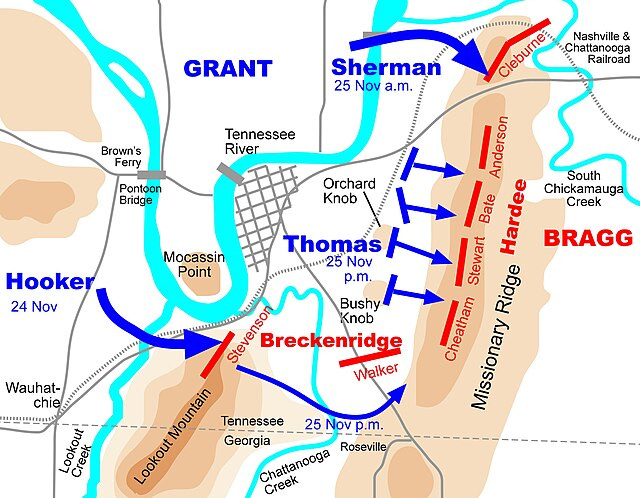
Grant’s operational design for the relief of Chattanooga was a testament to his belief in the power of simultaneous pressure. He envisioned a coordinated assault that would strike both extremities of the Confederate position while holding the center in place. This plan required a high degree of synchronization between three distinct and disparate commands. Joseph Hooker would lead the effort on the Union right by striking the northern slope of Lookout Mountain. William T. Sherman was tasked with the most critical component of the movement. He was to move his forces upstream and cross the Tennessee River by pontoon bridges to launch a heavy blow against the northern end of Missionary Ridge. Finally, the Army of the Cumberland, under George H. Thomas, was to perform limited holding attacks against the Confederate center. Grant hoped that these multi-axis movements would force Bragg to thin his lines and eventually lead to a collapse of the entire defensive front.
The first significant success of this offensive occurred on 24 November during the engagement that became known as the Battle above the Clouds. Joseph Hooker sent the better part of three divisions against three Confederate brigades that were perched on the rugged slopes of Lookout Mountain. The physical difficulty of the terrain was compounded by an intermittent fog that enshrouded the peak and created a surreal and disorienting atmosphere for the combatants. The Union infantry showed remarkable tenacity as they scrambled uphill over massive boulders and through tangles of fallen trees. Despite the natural advantages of the defensive position, the Confederate resistance was surprisingly brittle. The federal troops drove the rebels down the reverse slope of the mountain with fewer than 500 casualties. The height of the mountain, and the presence of the mist, gave the victory a legendary quality in the minds of the Northern public. However, the true significance of the day was operational. Braxton Bragg was forced to evacuate his defenses on Lookout Mountain that night and pull the survivors back to the main Confederate line on Missionary Ridge.
While Hooker achieved a dramatic victory on the right, the Union effort on the northern flank encountered severe difficulties. William T. Sherman launched his attack against the main spine of Missionary Ridge on the morning of 25 November. He expected to find a vulnerable flank that could be defeated in detail. Instead, his veteran troops ran into the formidable division of Patrick Cleburne. Cleburne was perhaps the most capable tactical commander in the Army of Tennessee, and he had arranged his defenses with professional skill. Throughout the morning and into the early afternoon, Sherman’s forces launched repeated assaults against the northern heights. Each of these attempts was repulsed with heavy losses. The terrain favored the defenders, and the Confederate infantry fought with a desperate resolve that Sherman had not anticipated. This stalemate on the northern flank threatened the entire Union offensive. Grant realized that if Bragg could continue to shift reinforcements to Cleburne, the Union plan would dissolve into a bloody and unproductive struggle for a few yards of mountain soil.
To break this deadlock, Grant decided to utilize the Army of the Cumberland. In the mid-afternoon of 25 November, he ordered George H. Thomas to launch a limited assault against the center of the Confederate line. The objective of this movement was specifically restricted. The Union soldiers were directed to seize the first line of Confederate rifle pits at the base of the west slope of Missionary Ridge. Grant intended this to be a supporting action that would prevent Bragg from sending more reinforcements to oppose Sherman. Thomas sent four divisions that consisted of 23,000 men across the open plain in front of the ridge. The sight of this massive blue wave moving with such precision was one of the most spectacular displays of military power during the war. The soldiers swept over the first line of trenches with an ease that surprised both the Union and Confederate high commands.
At this point, the battle escaped the control of the generals and became a struggle driven by the initiative of the individual soldier. Finding themselves under heavy fire from the second and third lines of trenches further up the slope, the men of the Army of the Cumberland did not halt at the rifle pits as they had been ordered. Instead, they began to move up the steep ridge of their own accord. They went forward, first by platoons and companies, and then by entire regiments and brigades. Sixty regimental flags raced each other toward the summit. This spontaneous charge defied the traditional logic of the defensive strength of heights. The Union officers initially tried to stop the ascent, but they were soon swept along by the momentum of their men. One notable example of this raw heroism was Lieutenant Arthur MacArthur, father of General Douglas MacArthur, who was later awarded the Medal of Honor for his actions during the climb. The Confederate defenders on the crest looked down in amazement at a sight that should have been a tactical impossibility.
The psychological weight of the defeat at Chickamauga served as a powerful catalyst for this assault. As the Union soldiers neared the top of the ridge, they began to shout the name of their previous defeat in derisive triumph. The cry of “Chickamauga! Chickamauga!” echoed across the valley as a form of verbal revenge against an enemy that had humiliated them only weeks before. The sound of thousands of men screaming this name while they charged up a vertical slope shattered the morale of the Confederate infantry. The defenders began to gape with amazement and then they began to panic. The Army of Tennessee, which had held its ground so stubbornly in the woods of Georgia, suddenly broke and fled in total disorder. The Confederate army disintegrated into a precipitate retreat. Soldiers threw away their blankets and knapsacks, and even their weapons, as they ran to escape the closing Union net. Surprised Union soldiers beckoned to their comrades and marveled at the sight of the rebel retreat. The dramatic assault up Missionary Ridge shattered the Confederate defenses and fundamentally reversed the strategic consequences of the tactical defeat at Chickamauga.
The Retreat That Opened the Deep South
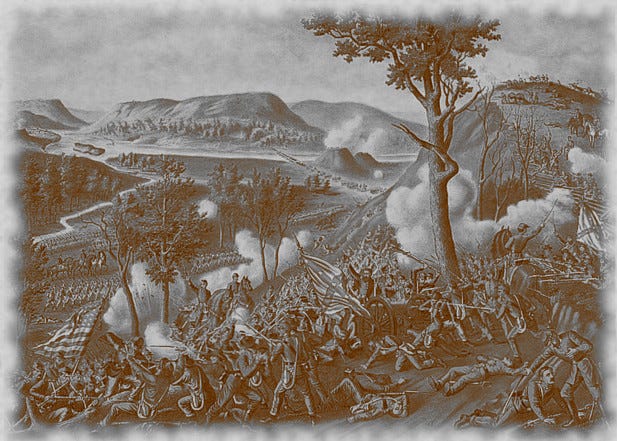
The disintegration of a military force is a process that occurs first in the mind, and then in the legs of the infantryman. At Chattanooga, the physical collapse followed a psychological surrender that had begun during the terrifying ascent of the ridge by the Union soldiers. Once the Confederate line snapped, the retreat became a frantic race toward the south that lacked any vestige of tactical order. Braxton Bragg’s army retreated thirty miles down the railroad toward Atlanta, and did not stop to regroup until it had put significant distance between itself and the pursuing federal forces. This railroad line represented more than just a path of escape for a beaten army. It was the primary artery for the defense of the Deep South. By abandoning the high ground of the Tennessee border, Bragg had effectively invited the Union war machine into the heart of the Georgia interior. The loss of such a dominant defensive position was not merely a tactical setback, but also an admission of operational bankruptcy that left the Confederate heartland vulnerable to a final and devastating blow.
Bragg’s response to the defeat was characteristic of his caustic and defensive personality. He refused to accept any measure of responsibility for the catastrophe that had befallen his command. Instead, he turned his vitriol upon the soldiers who had suffered through the carnage of the battle. Bragg wrote to the authorities in Richmond and claimed that no satisfactory excuse could be given for the shameful conduct of the troops. He argued that the position on the ridge was so naturally formidable that it ought to have been held by a mere line of skirmishers against any force the enemy could bring to bear. This indictment of his own men revealed a profound and terminal disconnection between the general, and the reality of modern combat. It failed to account for the cumulative exhaustion and the total loss of confidence that had hollowed out the Army of Tennessee over the preceding months. When a commander views his own men as the primary obstacle to victory, the institution of the army has reached a point of decline from which there is no easy recovery.
Grant recognized the vulnerability of the retreating rebels and launched a pursuit the next day. He sought to convert the tactical breakthrough into the total annihilation of the enemy force before it could establish new defensive lines. However, the pursuit was momentarily halted by the skill of a single Confederate division that had remained intact amidst the chaos. Patrick Cleburne had held the northern flank of Missionary Ridge with great effectiveness, and he once again demonstrated his tactical competence by organizing a rearguard action at Ringgold Gap. This display of professional discipline allowed the remainder of Bragg’s shattered army to retire further into Georgia to regroup and refit. Despite this brief respite, the strategic initiative had passed irrevocably to the Union. The Confederate forces were now fighting a desperate defensive war to protect the last remaining industrial and agricultural centers of the lower South.
The failures at Chattanooga were compounded by the collapse of the secondary Confederate effort in East Tennessee. James Longstreet had been detached from the main army in a move that significantly weakened Bragg’s position on the ridge. He launched an attack against the Union garrison at Knoxville in a bid to reclaim the region and provide some relief for the main army. This assault was repulsed on 29 November, with heavy casualties for the Southern troops. The failure of this diversionary maneuver meant that the Union now held firm control over the entire geographic corridor from the Ohio River to the Georgia border. The repulse at Knoxville deepened the Confederate woes and left the remnants of the Army of Tennessee isolated and demoralized. The campaign that had begun with such high hopes in the wake of the tactical triumph at Chickamauga had reached a conclusion that was as total as it was humiliating for the Confederate cause.
The internal crisis of the Confederacy reached a boiling point in the days following the retreat. The defeat at Chattanooga forced a final reckoning with the controversial leadership of Braxton Bragg. The animosity between the general and his subordinates was no longer a private matter of the headquarters, but was a public scandal that threatened the stability of the entire government. Bragg eventually submitted his resignation, and Jefferson Davis was forced to accept it. This transition in command occurred at a moment when the Confederacy could least afford a period of institutional instability. The loss of the gateway to the south meant that the industrial heartland was now exposed to the relentless logic of Union total war. The strategic consequences of the campaign were now clear to all observers. The North had not only won a major battle, but had dismantled the primary defensive barrier of the rebellion. What began as a Confederate battlefield triumph ended as a strategic disaster that weakened their capacity to resist future Union offensives.
The Strategic Meaning of a Tactical War
The operations conducted throughout the autumn of 1863 in the theater of the Tennessee River reveal a fundamental truth about the nature of high command and the limits of tactical violence. The Chickamauga Campaign, and the subsequent Battle of Chattanooga, demonstrated that battlefield success alone could not secure a lasting strategic victory. The Confederate gains won at such high cost on the banks of the Chickamauga dissolved through a combination of command hesitation and internal discord. At the same time, the Union forces displayed a level of resilience and logistical recovery that transformed a near-total defeat into a decisive advantage. This sequence of events serves as a stark reminder that the strength of a military institution resides in its ability to strike a blow, and in its subsequent capacity to absorb a counterstroke while maintaining its organizational integrity.
The narrative of this campaign began with the intricate maneuvering through the mountain gaps of northern Georgia. It reached a bloody crescendo during the desperate stand at Snodgrass Hill. It then transitioned into a test of human endurance during the starvation conditions within the besieged city of Chattanooga. Finally, it culminated in the dramatic and spontaneous assault up the face of Missionary Ridge. Throughout each of these phases, the campaign unfolded as a continuous interplay between command decisions, logistical realities, and battlefield execution. The Confederate forces repeatedly demonstrated their tactical effectiveness in the initial meeting engagements. Yet, they failed to synchronize their efforts or exploit their successes because of the corrosive friction within their leadership. The Army of Tennessee was an organism that could fight with ferocity, but struggled to think with institutional clarity.
In contrast, the Union forces showed an impressive ability to adapt to the changing circumstances of the war. Although they were initially fractured and humiliated, they underwent a process of rapid leadership reform and operational coordination. The arrival of Ulysses S. Grant, and the subsequent reorganization of the command structure, allowed the North to integrate its vast material resources with a coherent strategic vision. The opening of The Cracker Line was an achievement of the same magnitude as the charge up the ridge. This logistical success provided the physical foundation for the offensive that followed. It proved that in the modern era, the ability to feed and equip an army is a prerequisite for any meaningful tactical maneuver. The soldiers who shouted the name of their previous defeat while they ascended the heights of Missionary Ridge were no longer the broken men of September. They were the instruments of a rejuvenated military system that had learned to prioritize the mechanics of victory over the drama of the single engagement.
The campaign underscores the reality that wars are decided by more than victories on the field of battle. They are determined by the capacity of a nation to integrate unity of command, logistics, and strategy into a program of sustained action. The Union achieved this integration at Chattanooga, and thereby opened the geographical and psychological path to Atlanta. The Confederate failure to capitalize on the victory at Chickamauga was more than a missed opportunity. It was a failure of the Southern military system to function as a unified and professional whole. By the time the Union flags were planted on the crest of Missionary Ridge, the strategic landscape of the Western Theater had been fundamentally altered. This outcome hastened the eventual collapse of the Confederacy by exposing its heartland to the relentless logic of Union industrial warfare. The lessons of Chickamauga and Chattanooga remain essential for any student of the profession of arms who wishes to understand the precarious link between the winning of a fight and the winning of a war.
See Also


Bibliography/Further Reading
Hattaway, Herman, and Archer Jones. How the North Won: A Military History of the Civil War. University of Illinois Press, 1983.
Hattaway, Herman, and Archer Jones. Why the South Lost the Civil War. Edited by Richard E. Beringer. University of Georgia Press, 1986.
McPherson, James M. Battle Cry of Freedom: The Civil War Era. The Oxford History of the United States, v. 6. Oxford University Press, 1988.
Stewart, Richard W., ed. American Military History : The United States Army and the Forging of a Nation, 1775-1917. Vol. 1. Center of Military History, United States Army, 2010.
The attack on Missionary Ridge was, in different places, ordered by the officers. Some said, after the battle, that they had not gotten the part of the order about stopping at the rifle pits; others, that they assumed that part had been garbled; and others, that they had realized immediately, on capturing the pits, that the position was untenable.
In other places, the men took on their own initiative because they realized the same thing the last group of officers did.
It wasn't a uniform situation.
I grew up there.