

Our Finest Hour
The Allies' Path to Triumph in the Second World War

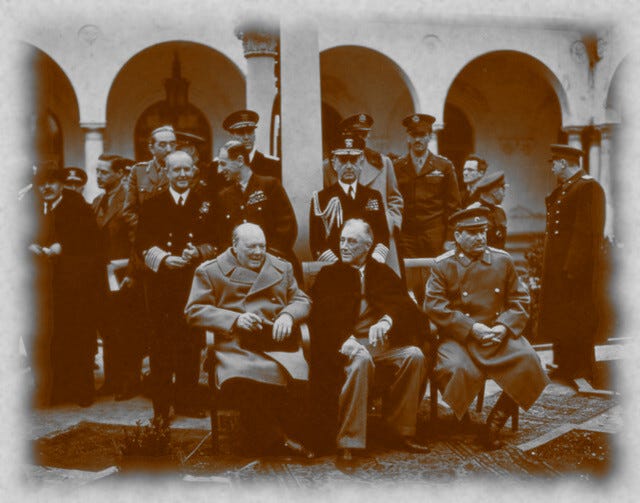
The Second World War, the worst war in human history, engulfed the globe, leaving a trail of devastation in its wake that resulted in more than fifty million lives lost. Though things were bleak in the early years, the Allied powers emerged victorious over the Axis, and reshaped the world order. Through economic superiority and industrial capability that enabled sustained production of the supplies and machines needed to defeat the Axis, along with unified political and military leadership exercising strategic brilliance on the vast battlefields, taking advantage of Axis over-extension and critical missteps, the Allies defeated the forces of evil that had crushed Europe under the jackboot, and had subjugated Asia under the rising sun.
Allied Economic and Manpower Superiority
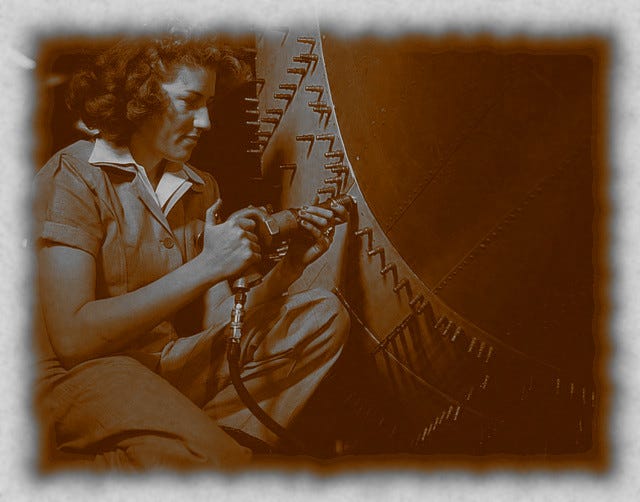
One of the major keys to victory was the enormous economic and manpower resources of the Allied powers, particularly the United States, compared to the Axis. Between the years of 1939 and 1944, the United States more than doubled its gross national product. After America’s entry into the war, federal expenditures increased from thirteen billion annually to 71 billion in 1944. Factory utilization increased from forty to ninety hours per week as this massive industrial giant was awakened.1 The industrial and economic behemoth of the United States would be the foundational Allied advantage—with Great Britain, who had to liquidate most of its overseas empire to pay for the war, and the Soviet Union, which had to relocate most of its factories as the Wehrmacht ravaged the industrial heartland of the Soviet Empire, relying on American financial and material aid to bolster their war efforts.
Axis Industrial Weaknesses and Downfall
By comparison, the Axis powers were in a much weaker industrial and economic position, which was a major contributing factor in their ultimate downfall. The island empire of Japan relied almost entirely on imports to sustain their industrial output. Lacking resources at home, nearly all of their nickel, rubber, and oil supplies had to be shipped to the mainland.2 This weakness would eventually be exploited by the United States submarine fleet following the 07 December 1941 attack on Pearl Harbor. Italy was in far worse shape economically and industrially than Japan. While Germany’s expenditures during its rearmament neared 7.5 billion, Italy’s military spending never exceeded $746 million. While Germany had a strong industrial base for manufacturing war materials, Italian manufacturing relied on artisan methods rather than the stamped steel and mass production factories of the other powers involved.3 Though Germany had this strong industrial foundation, Hitler refused to fully mobilize it for war until 1942, not wanting to reduce the standard of living for the German people. The result was a stagnant gross national product that only rose from 129 billion to 150 billion Reichsmarks between 1939 and 1943—critical years of the war for Germany.4 This disparity in resources and industry favored the Allies in a protracted conflict, but only if they could survive the opening stages and rapid advances of the Axis’ war machine.
Lend-Lease: The Material Turning Point
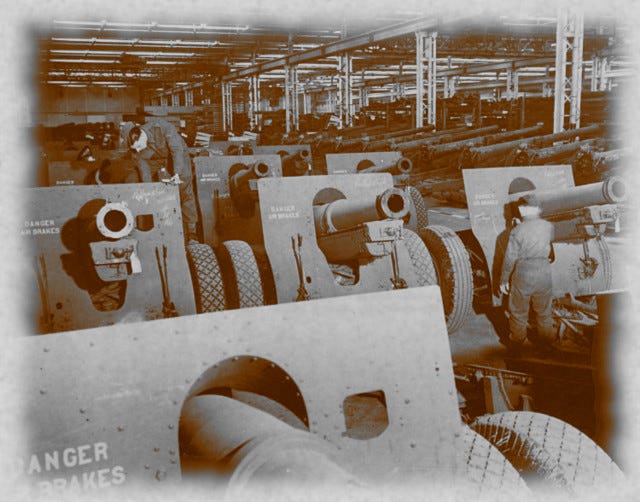
Despite early Axis gains, the material turning point came when the United States, through its Lend-Lease legislation—passed by Congress on 11 March 1941 at President Roosevelt’s insistence5—and its unrivaled production transformed the Allied economic and industrial advantage into an overwhelming flood of material that reached into every theater of the war. The Lend-Lease Act allowed Britain, and by later extension, the Soviet Union, to borrow critical military equipment from the United States on the promise of repayment at the conclusion of the war. This provided Britain, an island nation like Japan that relied on imported goods, with 185,000 trucks and 12,000 tanks over the course of the war.6 Lend-Lease also provided the beleaguered Soviets with three million tons of gasoline, hundreds of thousand of trucks, 2000 locomotives, 11,000 rail cars, and millions of pairs of winter boots, sustaining the Red Army’s counteroffensive against the over-extended Wehrmacht on the Eastern Front.7 With the ‘Arsenal of Democracy’ flowing at full volume across the ocean, the Axis powers were confronted with a material avalanche that they could neither equal nor endure, shifting the war from early Blitzkrieg successes to a grinding battle that they were doomed to lose.
Soviet Resilience and Industrial Relocation
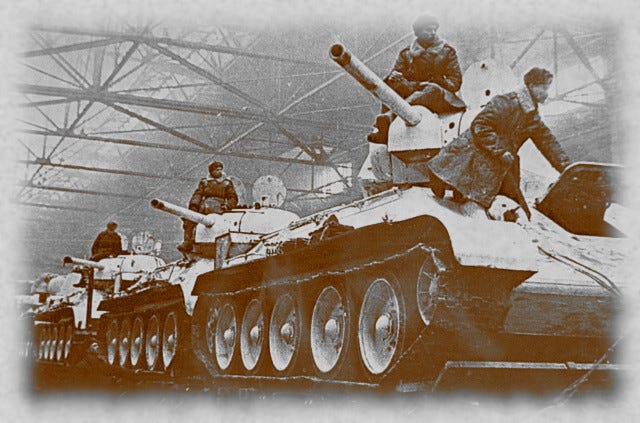
It is worth noting that, complementing American aid, the resilience of the Soviet Union, through a massive industrial relocation from the regions overran by the Wehrmacht, preserved critical production of tanks and artillery from German capture and losses from aerial bombardment. Between August and October 1941, at the height of Operation Barbarossa, the Soviet Union utilized their immense manpower and railway resources to relocate eighty percent of their war industry eastward. This unprecedented industrial evacuation included a heavy tank works plant responsible for building and assembling the T-34—arguably the best tank of the war—and the Novo-Kramatorsk heavy-machine works. In less than ten weeks after the extraordinary industrial evacuation, the Kharkov Tank Works, now relocated to Chelyabinsk, was operating at full capacity and produced twenty-five T-34 tanks on 08 December 1941.8 Over the winter months of 1941-42—a winter that took its attritional toll on the invading Germans—these relocated factories would churn out an astonishing 4,500 tanks, 3,000 aircraft, 14,000 artillery pieces, and 50,000 mortars.9 This industrial resilience on the Eastern Front, coupled with the material support of Lend-Lease, demonstrates the Allies’ ability to adapt under the most extreme of circumstances.
Political and Social Contrasts: Allied Unity vs. Axis Atrocities
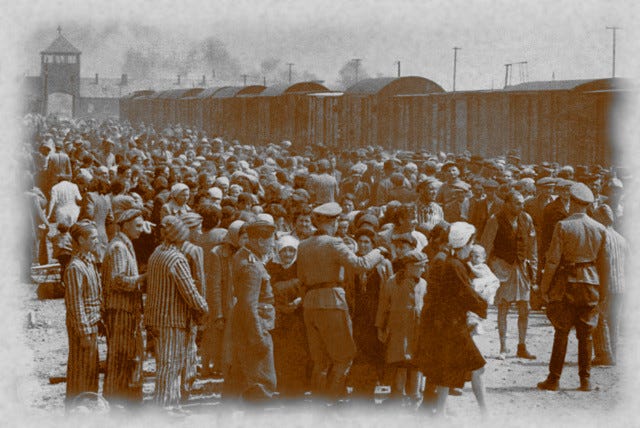
Politically and socially, the Western Allies benefited from structures that promoted coalition unity and humane treatment of populations (the exception being the Soviet Union’s repressive regime), contrasting sharply with the racial motivations of Germany and its brutal exploitation of human resources. Hitler’s Nazi regime rose to power through the stab-in-the-back myth at the conclusion of the First World War, blaming the German government for the defeat of the German army. The government was not the only source of Nazi ire. The racial purist ideology of Hitler’s regime aimed to eradicate the Jews, believing them to be equally responsible in their Great War defeat. Prior to the outbreak of war, 150,000 of Germany’s Jewish population, which numbered a half million, had fled. Tragically, many of them resettled in areas that would later fall under the grip of the Gestapo and SS. In January 1942, the “Final solution to the Jewish question” was formalized at the Wannasee meeting, putting the holocaust at full speed ahead. Utilizing forced labor camps such as Dachau, combination camps like Auschwitz, and purely death camps like Treblinka, by the conclusion of 1943, six million Jews had been murdered.10 The atrocities of the Nazi terror didn’t end there. Captured Soviet soldiers were treated with equivalent brutality—forced into slave labor or executed outright. 3,300,000 Soviet prisoners, out of more than five million captured on the Eastern Front, died in German captivity. By 1944, there were only 875,000 Red Army prisoners recorded, most working in labor camps.11 The profound and systematic dehumanization enabled the Allies to rally global support as the Axis progressively bled themselves, intentionally, of manpower and morale through racial motivations.
Allied Leadership: Adaptation and Foresight
The political and military leadership of the Allies contributed to victory through adaptive policies, command reforms, and strategic foresight that overcame early setbacks. Though the United States remained an isolationist nation while the Axis empires were aggressively expanding, President Roosevelt had enough forward vision to see that war would not stay out of America’s sphere of influence for long. Using his uncanny rhetorical skill, through speeches like the ‘Arsenal of Democracy,’ he convinced the nation of the necessity for armament, doubling the fleet, funded nearly 8,000 combat aircraft, and expanded the army from 200,000 to one million men via conscription, with little grumbling from the isolationist public.12 It was this same rhetorical mastery that convinced Congress to pass the Lend-Lease Act, gearing the industrial might of the United States in support of Allied resistance. Winston Churchill also emerged as one of the great leaders of the war, rallying the British to a spirited defense, and boosting British morale during the dark days of the aerial Blitz. For retaliation of the bombings, Churchill urged bomber attacks on the German homeland, focusing RAF bomber command towards increasing heavy bomber production and prioritizing aerial economic warfare, culminating in devastating aerial bombardments against Germany’s industry, where the British engaged in saturation bombing by night and American B-17s prioritized precision bombing by day.13 Joseph Stalin, though repressive at first, purging much of the Red Army in 1938, was able to recover from these setbacks. By June 1940, 479 officers of the Red Army were appointed as major-generals—the largest mass promotion in any army’s history.14 In fact, Stalin’s leadership had shifted positive so much so that General Zhukov assessed Stalin as a brilliant military economist.15 This adaptability in leadership stood in stark contrast to the ideological rigidity of Axis leadership.
Axis Leadership: Missteps and Overreach
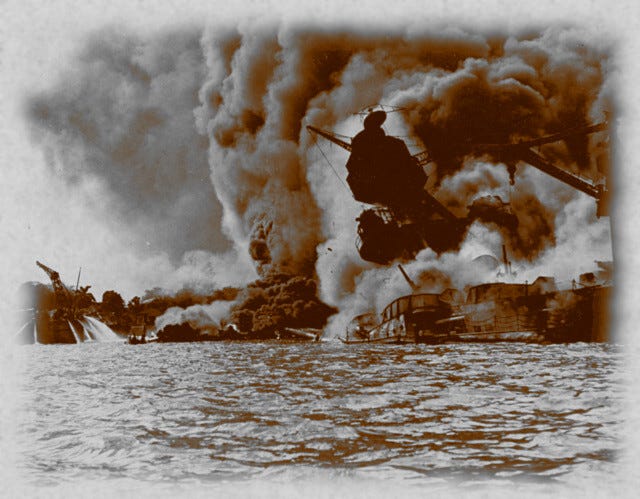
Hitler, Mussolini, and Hideki Tojo of Japan exacerbated defeats through missteps and overambitious offensives that often led to unsustainable commitments. Hitler micromanaged the workings of the German army, dissolving the War Ministry and appointing himself head of the OKW, envisioning himself as a warlord in the vein of Frederick the Great. Military strategy, provided through Fuhrer directives, flowed from Hitler directly to the OKW and OKH.16 This top-down structure often led to the dismissal of competent commanders like Guderian, Brauchitsch, and Manstein over perceived inadequacies, with failures blamed on field commanders despite Hitler’s insistence on his ambitions overextending the Wehrmacht. Unlike Stalin, who shifted his methods, Hitler proved unable to retreat from his ideologically driven mindset. The failed 20 July 1944 assassination attempt served to further his ideological entrenchment, abolishing the traditional military salute and only allowing the Nazi salute to be given by all servicemen.17 Adding to these complications were Mussolini’s atrocious command, with frequent bad decisions compounding the precarious military position of the Axis. These missteps include Mussolini’s poor decision to attack Greece from Albania on 28 October 1940.18 Setbacks in this effort required German intervention, pulling focus away from Hitler’s desire to invade Russia. Mussolini also bungled his African campaign, compelling Hitler to further spend resources in tertiary campaigns to rescue his flailing ally.19 In Asia, Japanese leadership grossly miscalculated American resolve, responding to the American oil embargo with a surprise attack on Pearl Harbor on 07 December 1941. Though initially crippling the American Pacific Fleet, the strategic blunder of not attacking the fuel depots and submarine pens would cost them dearly, as the United States submarine fleet would wreak havoc on Japanese military and merchant shipping in the years to come. This contrast in leadership directly shaped outcomes, enabling the Allies to exploit over-extensions caused by strategic failures and ideological rigidity.
Strategic Objectives: Attrition vs. Conquest
Strategically, the Allies pursued attrition and encirclement to wear down Axis forces, capitalizing on superior logistics in opposition to Axis goals of rapid conquest and Lebensraum that proved unsustainable. This coincided with Hitler’s ideological ambitions to confront and uproot Jewish Bolshevism from eastern Europe, providing new areas of settlement for ethnically pure Germans—the primary motivation behind the Barbarossa campaign that doomed the Wehrmacht.20 Though initially successful, conducting a series of large encirclements through White Russia in an advance on Moscow, the Red Army was able to recover. Red Army leadership after Stalingrad turned Germany’s own tactics against them, with generals Zhukov and Vasilevsky outlining a wide encirclement of the beleaguered German Stalingrad forces, forcing the surrender of Reichsmarschall Paulus’s Sixth Army.21 After Normandy, the Americans and British on the Western Front also adopted encirclement tactics, such as General Bradley’s massive, fifteen-mile ensnarement of German defenders in Argentan near the Falaise pocket. Supporting these offensives were logistical innovations like the Red Ball Express—a truck route across Western Europe to the Allied front lines aimed at sustaining rapid advances across France.22 It was exactly this kind of innovation against Axis failures that set the stage for some of the most decisive battles of the war.
“Not One Step Back” and the Penetration of the Atlantic Wall
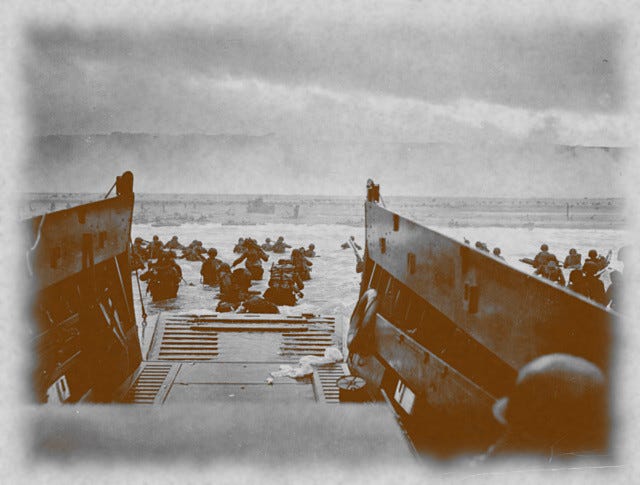
Pivotal battles on the Eastern and Western Fronts, including Stalingrad, Kursk, and Normandy, inflicted irreplaceable losses on the Axis, recapturing conquered territory and paving the way for the encirclement of Berlin and the ultimate defeat of the Nazi empire. On 19 November 1942, the thunder of thousands of Russian guns opened up the Red Army’s counteroffensive in Stalingrad. Completely cut off, the Germans suffered heavy losses. After withering urban combat, the last German units in Stalingrad surrendered on 02 February 1943. Overall, German losses in the Battle of Stalingrad totaled more than 400,000.23 The Red Army’s victory at Stalingrad caused disorder on the German southern front, presenting an opportunity for the Soviet Union to seize the initiative and expel the Wehrmacht from Ukraine—Germany’s most valuable territorial acquisition.24 The setbacks of Stalingrad paved the way for the decisive Battle of Kursk, where the strategic initiative shifted to the Red Army, never to be recovered by Germany for the remainder of the war. Utilizing deep defensive preparations and innovative anti-tank tactics, the Red Army repelled Germany’s attempt to cut the neck of the Kursk salient, resulting in extensive manpower and vehicle losses, depleting Germany’s central armored reserves. The losses were irreplaceable, as they could not be replenished by the German’s straining industry.25 The final blow in the European Theater would come from a second front opening in Northern France, showcasing Allied logistical and strategic superiority. The invasion of Normandy, codenamed Overlord, was initiated on 06 June 1944. It remains the largest amphibious assault in human history. Following an unprecedented airborne operation inland, naval gunfire from the channel pounded coastal defenses in preparation for the landings, which began at 06:30am on 06 June. After fierce fighting to secure the beaches, particularly on Omaha beach, where the 1st Division faced the elite German 352nd Division, the allies were in possession of all chosen landing sites. The beachhead came at the cost of 6,500 Americans, and 3,000 British and Canadian lives—most of the American lives lost on D-Day occurred at Omaha.26 Supporting the invasion force was a logistical effort ranging from vast quantities of weapons to stockpiles of dental fillings. This was all shipped to Britain prior to the invasion and then ferried across the channel after the invasion, ensuring Allied troops could continue the advance deep into France.27 These European turning points ran parallel with gains in the Pacific, where naval and air dominance eroded Japan’s ability to sustain the war, accelerating the push towards unconditional surrender and ultimate victory.
Decisive Engagements in the Pacific: Midway, Submarine Warfare, and Strategic Bombing
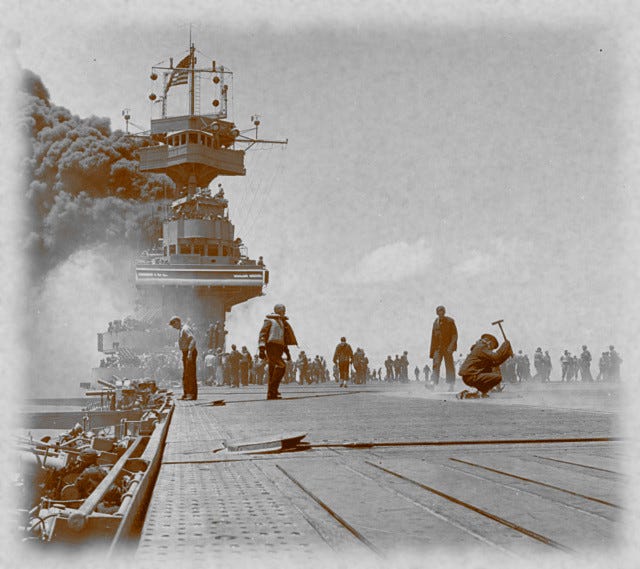
In the Pacific theater, battles such as Midway, Leyte Gulf, aggressive submarine attrition, and the strategic bombing campaign exemplified Allied supremacy, depleting Japanese resources and compelling surrender without a costly invasion of the home islands. Prior to the Midway confrontation, Magic intelligence had masterfully deciphered Japanese intentions by sending a false message that Midway was out of water. An antenna based in Australia intercepted a Japanese transmission relaying that AF was short of fresh water, confirming the intended target, depriving Japan of the element of surprise it had enjoyed in the prelude to the Pearl Harbor attack. A Catalina reconnaissance aircraft patrolling the airspace around Midway spotted the invasion fleet on 03 June 1942, giving commanders ample time to prepare a spoiling attack.28 During the course of the battle, the once invincible Kido Butai—the Japanese carrier assault force—was annihilated. The carriers Akagi, Kaga, and Soryu were destroyed within the first five minutes of the battle. Hiryu evaded the morning strike but was located by Enterprise dive bombers at 5:00 pm. Four direct hits set the carrier ablaze from bow to stern, forcing its scuttling.29 Kido Butai, once the pride of the Empire of Japan, was no more. The United States Navy now ruled the Pacific. Adding to the crippling of the Japanese navy was the relentless attrition campaign by the silent hunters of the Pacific—the American submarine fleet that Japan failed to attack during its Pearl Harbor raid. American submarines critically weakened Japan by inflicting massive losses on its merchant fleet, cutting Japanese industry off from the raw materials of Southeast Asia it so desperately needed to keep up the fight.30 As the Pacific campaign drew to a close, Japan was reduced to twelve percent of its pre-war shipping levels. Submarines accounted for a majority of the losses, sinking six hundred merchants totaling 2.7 million tons in 1944 alone.31
The Pinnacle of Destruction: The Atomic Bombings
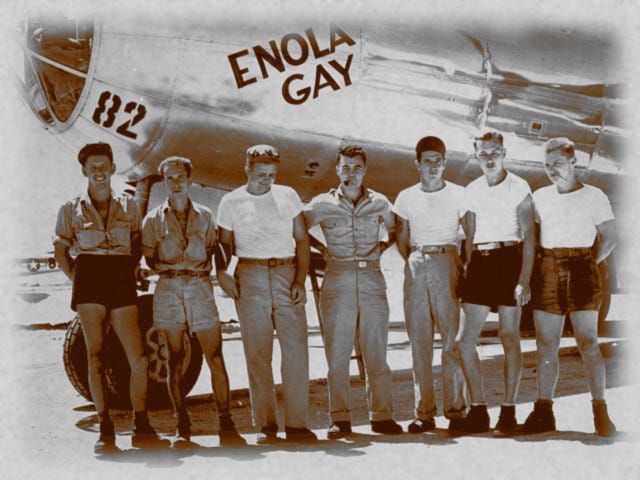
The attrition culminated in the strategic bombing campaign that wrought devastation on Japanese cities. By 1945, 250 B-29 Superfortresses operated non-stop, shifting strategy from high-altitude precision bombing to low-level, incendiary night attacks against the paper and wooden structures of Japan’s urban landscape. The 09 March 1945 attack on Tokyo, alone, involved 325 aircraft and resulted in 89,000 dead—more than the Hiroshima atomic attack—and left 16 square miles of the largest city in the world in ashes. By July 1945, the strategic bombing campaign had left sixty percent of Japan’s sixty largest cities smoldering.32
The atomic bombings represented the capstone of the strategic bombing effort, vaporizing Hiroshima and most of Nagasaki on 06 and 09 August 1945. As discussed in my article, The Cruel Bomb That Ended A Cruel War, these bombings were the final step in a strategic effort that ultimately led to Japan’s surrender. The day after the Nagasaki bombing, Japan sued for peace, formally signing the terms of unconditional surrender aboard the USS Missouri in Tokyo harbor on 02 September 1945.33 The costliest war in human history, both in blood and treasure, was over.
Victory Through Resolve: Lessons from the War
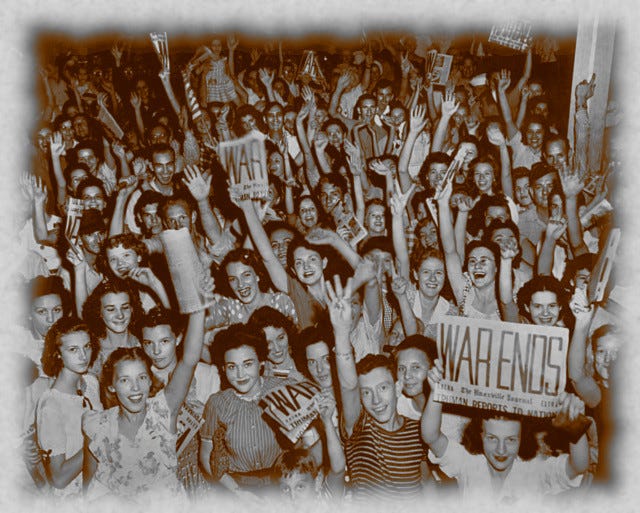
Ultimately, the Allies’ triumph in the Second World War was the result of an enormous economic and industrial machine, supporting brave and innovative soldiers in the mud and blood of the battlefields, boosted by effective leadership both at home and in the field, exploiting flaws in Axis strategy to shift the momentum of the war through decisive victories like Stalingrad, Kursk, and Midway. This victory not only ended Axis aggression but also reshaped global power dynamics, offering enduring lessons on the interplay between might, strategy, and unyielding resolve.
See Also


John Keegan, The Second World War (Penguin Books, 2005), 218–19.
Keegan, The Second World War, 213.
Keegan, The Second World War, 345–46.
Keegan, The Second World War, 211–12.
Keegan, The Second World War, 539.
Richard Stewart, ed., American Military History : The United States Army in a Global Era, 1917-2010 (Military Bookshop, 2010), 2:165.
Keegan, The Second World War, 122.
Keegan, The Second World War, 209–10.
Keegan, The Second World War, 220.
Keegan, The Second World War, 288–89.
Keegan, The Second World War, 284.
Keegan, The Second World War, 537.
Keegan, The Second World War, 147.
Keegan, The Second World War, 177.
Keegan, The Second World War, 454.
Keegan, The Second World War, 63.
Keegan, The Second World War, 504.
Keegan, The Second World War.
Keegan, The Second World War, 143.
Keegan, The Second World War, 141.
Keegan, The Second World War, 229.
Stewart, American Military History, 2:153-55.
Keegan, The Second World War, 234-36.
Keegan, The Second World War, 495.
Keegan, The Second World War, 468–71.
Stewart, American Military History, 2:149; Keegan, The Second World War, 387.
Stewart, American Military History, 2:147.
Keegan, The Second World War, 272–74.
Keegan, The Second World War, 278; Stewart, American Military History, 2:170.
Stewart, American Military History, 2:198.
Keegan, The Second World War, 212, 555.
Keegan, The Second World War, 575–77.
Stewart, American Military History, 2:199–201.