

The Red Ball Express
African American Valor and the Logistical Breakthrough That Won France

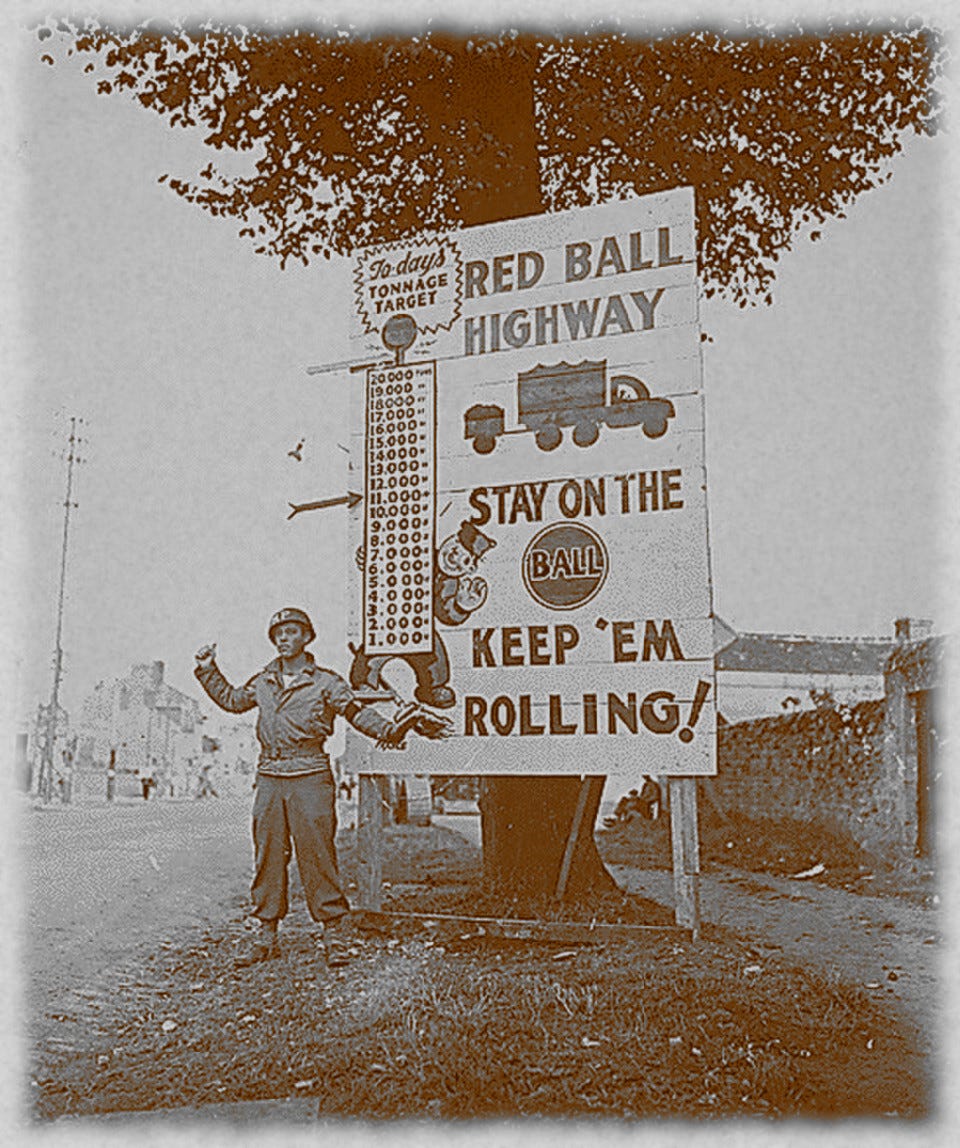
The collapse of the German Seventh Army at the Falaise Pocket in August 1944 transformed the struggle of the Normandy hedgerows into a war of maneuver that outpaced Allied planning. As General Patton’s Third Army pivoted through the Avranches gap and raced toward the Seine, the pursuit achieved a pace that rendered established rail-and-depot logistics obsolete within a matter of days. This rapid expansion of the front occurred within a landscape where the infrastructure had been systematically erased by Allied air power to prevent German reinforcement during the initial landings. The logistical paralysis threatened by the intentional destruction of the French rail network and the unprecedented speed of the pursuit was resolved only by the emergency implementation of the Red Ball Express, a massive motor transport system that utilized the resilience of African American Quartermaster units to sustain the offensive’s momentum.
The success of the Allied advance relied upon a paradox of strategic preparation. Under the “Transportation Plan” championed by Air Chief Marshal Sir Arthur Tedder, Allied bombers had spent the months preceding 6 June pulverizing the marshaling yards at Trappes, Villeneuve-Saint-Georges, and Juvisy to isolate the invasion bridgehead. While the bombing campaign successfully paralyzed the Wehrmacht’s ability to move reserves, it simultaneously deprived the Communications Zone (COMZ) of the primary means to move the 600,000 tons of supplies required monthly by the 12th Army Group. When the breakout occurred, the distance between the beachhead depots and the front line grew by as much as forty miles per day, forcing a shift from rail-based logistics to an improvised, high-speed truck route. This transition required the immediate diversion of thousands of general-purpose vehicles from across the European Theater of Operations to create a rolling supply line that functioned as a mobile extension of the port facilities.
The operational history of this trucking artery requires an evaluation of the strategic assumptions of Supreme Headquarters Allied Expeditionary Force (SHAEF) regarding French infrastructure and the resulting friction between combat speed and sustainment capacity. Specific technical focus rests upon the reliability of the deuce-and-a-half truck and the geographical constraints of the French routes nationales which dictated the convoy routes. The analysis incorporates the tactical conditions under which Quartermaster companies engaged bypassed German units and the physiological toll of continuous driving on the men of the motor pools. Central to this inquiry is the organizational structure of the segregated United States Army, which placed the burden of this sustained logistical effort on African American soldiers, whose performance under fire redefined the combat value of support formations during the drive to the German frontier.
The Air Campaign That Solved One Problem and Created Another
Even before the first troops waded ashore on 6 June 1944, Allied planners had deliberately turned their strategic bombers against France’s transportation network in order to paralyze German reinforcements, a choice that would later shape the entire supply situation once the breakout occurred. The genesis of this strategy lay in the “Transportation Plan,” a directive championed by Air Chief Marshal Sir Trafford Leigh-Mallory and the scientist Solly Zuckerman, which argued that the isolation of the Normandy beachhead required the total disintegration of the French rail system. Throughout April and May, the Eighth Air Force and RAF Bomber Command diverted heavy assets from the “Oil Plan” to strike seventy-four specific rail targets, including the massive marshaling yards at Trappes and the locomotive repair facilities at Hellemmes. This campaign succeeded in reducing the traffic capacity of the Société Nationale des Chemins de fer Français (SNCF) by nearly seventy percent across northern France. By targeting the nodes where rail lines intersected, the Allies ensured that the German Seventh Army could not receive the panzer reinforcements necessary to collapse the Allied lodgment.
The physical destruction of the rail infrastructure created a landscape of twisted steel and cratered beds that the Allied Communication Zone (COMZ) assumed would be repaired in tandem with a slow, methodical advance. Allied bombers shifted attention to transportation facilities in France specifically to restrict the enemy’s ability to move reserves against the invasion, a goal achieved by the destruction of twenty-six bridges over the Seine and the destruction of rail tunnels. The Ninth Air Force focused its B-26 Marauders on the choke points within the rail network, ensuring that no more than one-hundred locomotives remained operational in the Normandy sector by the end of June. This tactical success relied upon the absolute denial of movement, an operational objective that planners viewed through the lens of interdiction rather than future sustainment. The resulting vacuum in transit capacity was an intentional byproduct of the air campaign, designed to force German units like the 2nd SS Panzer Division into grueling, fuel-consuming road marches from southern France.
Logistical projections formulated by Supreme Headquarters Allied Expeditionary Force (SHAEF) during the winter of 1943–1944 operated on the premise that the liberation of France would proceed through distinct, time-phased objectives. Operation Overlord planners positioned depots in the area between Rennes at the base of the Breton Peninsula, and the city of Laval some ten miles to the east to create a supply base closer to American troops along the Seine. This arrangement presupposed that the rail lines connecting the Cotentin Peninsula to the interior of France would be restored by Army Engineers at a rate sufficient to keep pace with the infantry. Major General John C. H. Lee, commanding COMZ, operated under the assumption that the beachhead would be expanded at a measured pace, allowing for the rehabilitation of the rail line from Cherbourg to Le Mans. These depots were intended to serve as the stationary hubs for a logistics system that prioritized the buildup of massive stockpiles rather than the rapid delivery of materiel to high-speed columns of armor.
The disconnect between planning and the reality of the 1944 campaign was further exacerbated by the conservative estimates regarding the scale of the Allied force structure required for the initial liberation. The Communication Zone (COMZ), the command responsible for lines of communication and logistics in the liberated areas, had expected supply responsibilities for twelve divisions in the first ninety days following the invasion and then only in the area west of the Seine. This planning document, often referred to as the Neptune logistical estimate, did not account for the possibility of supporting and provisioning these forces in any offensive action beyond the river until after September 1944. The administrative apparatus of the U.S. Army intended for the advance to halt at the Seine to allow for the construction of permanent supply installations and the reopening of major ports. Only in October did the planners anticipate a advance beyond the Aisne River, a geographical objective located approximately seventy-five miles east of the Seine, which reflected a fundamental underestimate of the operational reach of American motorized divisions.
The scale of the destruction rendered these phased timelines impossible to maintain once the tactical situation became fluid. The very efficiency of the Allied air interdiction meant that the 1,500 miles of track supposedly available for Allied use in the Normandy region were largely non-functional. By early August, as the First Army under Lieutenant General Courtney Hodges smashed through the German lines at St. Lô, the lack of functioning locomotives and the destruction of the Juvisy-sur-Orge rail bridge meant that supplies could not move by the tonnages required for a mobile pursuit. The planners had succeeded in isolating the German army from its reinforcements, but they had also isolated the American army from its own depots. With the railroads lying in ruins and the armies surging forward after the St. Lô breakthrough, the gap between pre-invasion planning and postwar supply demands widened into a full-blown logistical emergency that could be bridged only by trucks.
A Breakout Too Fast for Its Own Supply Lines
Once American forces cracked open the German line near St. Lô on 25 July, and Patton’s Third Army raced through Avranches into Brittany and beyond, the speed of the advance transformed a manageable supply situation into a near-catastrophe, with gasoline and ammunition running short and depots rendered obsolete almost overnight. The Operation Cobra breakout, spearheaded by the 2nd and 3rd Armored Divisions, destroyed the defensive posture of the German Seventh Army and initiated a pursuit that fundamentally altered the spatial requirements of the campaign. By the time the VIII Corps secured the passage through the Avranches gap, the forward elements of the Third Army were consuming fuel at a rate that exceeded the delivery capacity of the existing Motor Transport Service. The sheer velocity of the armor meant that the tactical map changed faster than the Quartermaster Corps could establish fuel and ammunition transfer points.
The armies were going so far and so fast that the supply services were unable to keep pace with the shifting front. Although enough supplies were available in Normandy, the problem was to get them to forward positions sometimes more than 500 miles beyond the depots. The stockyards of the Cotentin Peninsula remained glutted with materiel, yet this tonnage was effectively frozen by distance. American armor and infantry advanced so rapidly through northern France in August 1944 that it was impossible to establish a fixed system of supply depots near the front. Orders for supply vehicles to rendezvous at designated forward depots were meaningless when trucks arrived because the depots had moved on with the combat forces shifting forward every day, sometimes every hour. This pursuit phase of the war necessitated a radical departure from the established doctrine of rail-to-road transfer, as the railheads remained bogged down in the ruins of Caen and Saint-Lô.
By early September, the scale of the logistical burden had outstripped the most optimistic projections of SHAEF staff. By 4 September, the Communication Zone was supporting sixteen, instead of twelve, U.S. divisions 150 miles beyond the Seine. This thirty-three percent increase in the number of combat divisions requiring sustainment occurred at the exact moment when the lines of communication were at their most attenuated. The administrative burden of managing sixteen divisions, each requiring approximately 600 to 700 tons of supplies daily, placed an immense strain on the 12th Army Group’s rear echelon. The logistical friction was compounded by the fact that the First and Third Armies were operating on diverging axes, with Lieutenant General Courtney Hodges moving toward the Belgian frontier and Patton driving toward the Saar, necessitating a wider and more complex distribution network than the original Overlord plans had envisioned.
The tactical instability of the front meant that even the most determined delivery efforts often ended in confusion or combat. Sometimes ammunition convoys were diverted to points as much as twenty miles beyond their original destinations, and when they arrived at a new area, they would have to wait while it was cleared of enemy troops. The 6th Armored Division, for instance, frequently outran its own protective screen, leaving the following truck companies to navigate roads still infested with bypassed German remnants from the 275th Infantry Division. These diversions forced drivers to expend precious fuel and time searching for the point of contact with combat units that were constantly in motion. The resulting lag in delivery meant that frontline units were frequently forced to prioritize certain sectors for ammunition expenditure, a rationing that slowed the overall momentum of the Allied drive.
By the end of August, the cumulative effect of these logistical failures reached a critical threshold. Despite extraordinary measures, such as establishing a one-way truck route called the Red Ball Express, supplies of such essential commodities as gasoline and ammunition began to run short. The Third Army’s advance towards the Meuse was nearly halted not by German resistance, but by the empty tanks of the 4th Armored Division. On 31 August, Patton’s divisions received only 32,000 gallons of the 400,000 gallons of gasoline they required to maintain their rate of pursuit. The crisis was no longer a matter of administrative inefficiency but a strategic threat that risked allowing the German forces to reconstitute behind the Westwall. Faced with this mounting emergency, Allied logisticians improvised on an unprecedented scale, converting the truck companies already in theater into the Red Ball Express, an around-the-clock trucking operation that would carry the burden the shattered railroads could no longer bear.
Building a Highway of Steel: The Emergency Birth of the Red Ball Express
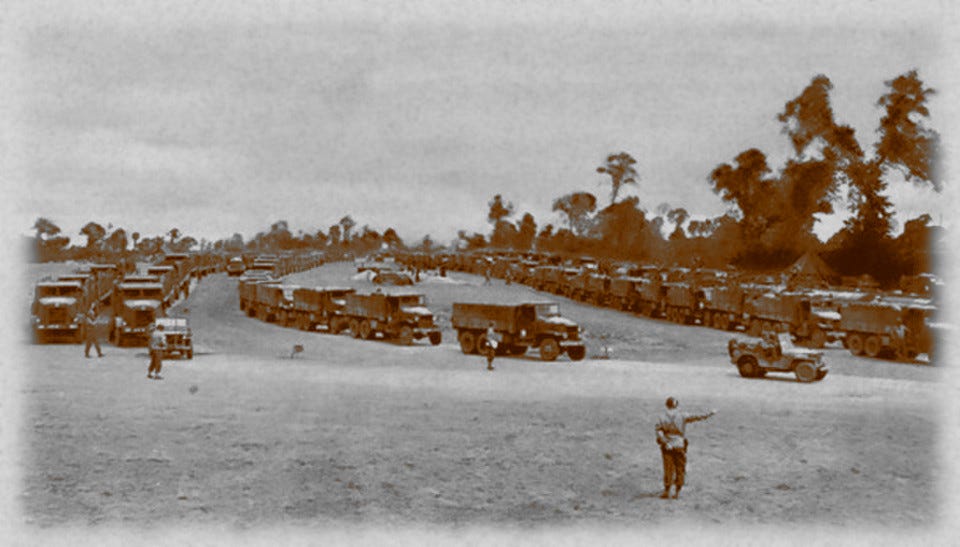
On 25 August, just days after the Seine crossing, the Red Ball Express began rolling to move critical supplies forward, growing rapidly into a vast convoy system that averaged 7,000 tons daily and kept the Allied armies in motion. This mobilization represented a desperate attempt to bridge the distance between the Normandy beachhead and the rapidly receding front by centralizing all available motor transport under the Motor Transport Service. Within ninety-six hours of the initial order, the Army had activated 132 truck companies, the majority being African American units, to operate a fleet of 5,958 vehicles. During the initial operational surge, these drivers moved over 12,000 tons of critical materiel, specifically gasoline and 105mm ammunition, from the base depots at St. Lô to the forward distribution centers at Chartres. The rapid concentration of these assets turned the French road network into a conduit for the mechanical sustenance of the Allied pursuit.
The operational duration of the Red Ball Express extended far beyond its intended emergency window as the Allied advance refused to settle into a static phase. When the system finally suspended activity in mid-November, it had maintained a sustained daily average of 7,000 tons of supplies over eighty-one consecutive days. Contrary to initial expectations, the Red Ball Express was operating east of the Seine in support of the advance, traversing the increasingly long distances required to reach the 12th Army Group’s forward positions. This eastward expansion saw convoys traversing a 400-mile, one-way loop that required constant maintenance and an exhausting cycle of driving shifts. The endurance of this system was the primary factor that allowed American commanders to maintain pressure on the retreating Wehrmacht across the French interior.
To overcome the inherent delays of fixed supply points, the U.S. Army improvised with the deuce-and-a-half “Jimmies” as rolling depots that followed the infantry directly into the engagement zones. These vehicles did not merely deliver to established rear areas but began delivering materiel right to the front lines where the infantry and armor happened to be engaged in combat. By maintaining a load of fuel and ammunition on the truck beds until the moment of consumption, the Motor Transport Service bypassed the traditional, time-consuming labor of unloading at intermediate depots. This improvisation converted the standard utility truck into a functional extension of the frontline combat unit’s own organic supply. A tank commander in the 4th Armored Division could thus refuel his M4 Sherman from a vehicle that had remained in motion since leaving the Cotentin Peninsula.
The requirement for concentrated heavy-lift capacity led the VIII Corps to further innovate by converting specialized heavy equipment for high-tonnage supply roles. Maintenance units modified massive M15 tank transporters into rolling Ammunition Supply Points whose flatbed trailers carried loads of up to fifty tons of ammunition and loaded five-gallon jerricans. These heavy convoys shadowed the infantry as they moved toward the Brittany Peninsula and later toward the German border, providing a high-density reserve of firepower that could be deployed without the need for railheads. The employment of these fifty-ton loads provided a critical buffer against the dry periods that plagued high-velocity armor operations. This heavy-lift capability ensured that the Allied advantage in artillery and fuel was never entirely severed by the geographic extension of the lines of communication.
General Patton recognized this logistical engine as the decisive factor in his pursuit of the German Seventh Army, eventually offering a formal commendation of the motor transport effort. Patton paid tribute to his “Jimmies” in a lengthy press release titled “The 2½-ton Truck Is Our Most Valuable Weapon,” wherein he argued that the vehicle’s utility was as essential as that of the tank. The deuce-and-a-halfs were seldom empty and never idle throughout the Third Army’s smashing drive. They hauled gasoline and ammunition forward, only to return full with German prisoners of war or the American wounded and dead. In several instances, such as the advance through the outskirts of Reims, these trucks carried infantry squads directly into towns held by the enemy under fire, effectively acting as improvised personnel carriers. The truck provided the American command with a level of tactical and logistical flexibility that the more rigid, rail-dependent German logistics could not match. Yet the success of the Red Ball Express depended not only on numbers and improvisation but on the courage and endurance of the men behind the wheel, who drove through enemy-held territory under constant threat.
When Logistics Became Combat
Operating far ahead of secure lines, Red Ball drivers faced German air attacks at dawn, strafing runs, sniper fire, and pockets of bypassed enemy troops, responding with return fire, dispersion tactics, and raw bravery that turned supply runs into running battles. The vulnerability of the convoys was most pronounced at geographic bottlenecks, such as the Sélune River bridge near Avranches, where the 3398th Quartermaster Truck Company encountered sustained Luftwaffe strafing runs. Between the late hours of August and early September, German fighters targeted this vital route with a persistence that defied the general Allied air superiority. The attacks typically commenced in the twilight hours, with German pilots dropping flares to illuminate the columns before initiating low-level strafing and bombing runs against the bridge and the waiting vehicles. Despite these conditions, the 3398th maintained its delivery schedule to Patton’s Third Army, with the truckers manning machine guns to return fire. The company eventually reported several German aircraft destroyed while limiting their own casualties to a single wounded soldier.
The danger intensified as convoys moved into the contested zones of the Brittany Peninsula, where German heavy ordnance remained a lethal threat to soft-skinned vehicles. On the approach to the besieged port of Brest, the drivers of I Company encountered this stark reality when their column was halted by the sight of a burning American tank in the road ahead. Almost immediately, German 88mm artillery, weapons capable of piercing the heaviest Allied armor, opened fire on the unarmored trucks. Several vehicles carrying thousands of gallons of gasoline were struck and ignited, creating a fireball that forced the drivers to abandon their cabs and seek cover in the roadside ditches. The engagement necessitated the intervention of M4 Shermans from the 6th Armored Division to suppress the German batteries before the surviving trucks could resume their mission.
The fluid nature of the Allied pursuit meant that the 12th Army Group often bypassed significant concentrations of German infantry, leaving the Red Ball drivers to navigate a rear area that was barely under Allied control. In one instance, a twenty-truck convoy entered a French village that intelligence had designated as secure, only to be met by a fusillade of small-arms fire from a concealed Wehrmacht platoon. The lead truck was caught in the kill zone, forcing the driver and his assistant to abandon the vehicle and retreat on foot while engaging the enemy with their M1s. The assistant driver was killed in the exchange, a casualty of the running battles that defined the logistical effort. These repeated encounters with bypassed pockets of the 275th Infantry Division and other fragmented units meant that Quartermaster trucks frequently required the protection of armored escorts to ensure the delivery of rations and ammunition to the spearheads.
The psychological and physical toll on the drivers was exacerbated by the lack of secure bivouac areas, which forced units to maintain a state of constant combat readiness even during designated rest periods. When I Company moved to a wheat field near Bricquebec, approximately seven miles west of Granville, the drivers spent their first night digging slit trenches to protect against night raids by the Luftwaffe. The sound of German aircraft at dusk became an ominous signal for the men to seek cover as the enemy attempted to disrupt the flow of supplies at the source. This persistent exposure to danger fostered a distinct combat identity among the motor pools. Drivers frequently pointed with pride to the bullet holes in their windshields and cabs, marking these as evidence of their runs through the avenues of snipers and aircraft. They reacted with marked belligerence toward any suggestion that the Quartermaster service constituted a soft life, as the evidence on their vehicles proved they were as much a part of the frontline struggle as the infantry they sustained. These dangers were borne disproportionately by one group of soldiers whose contributions have too often been overlooked in popular accounts of the campaign.
The African American Soldiers Who Carried the Advance on Their Axles
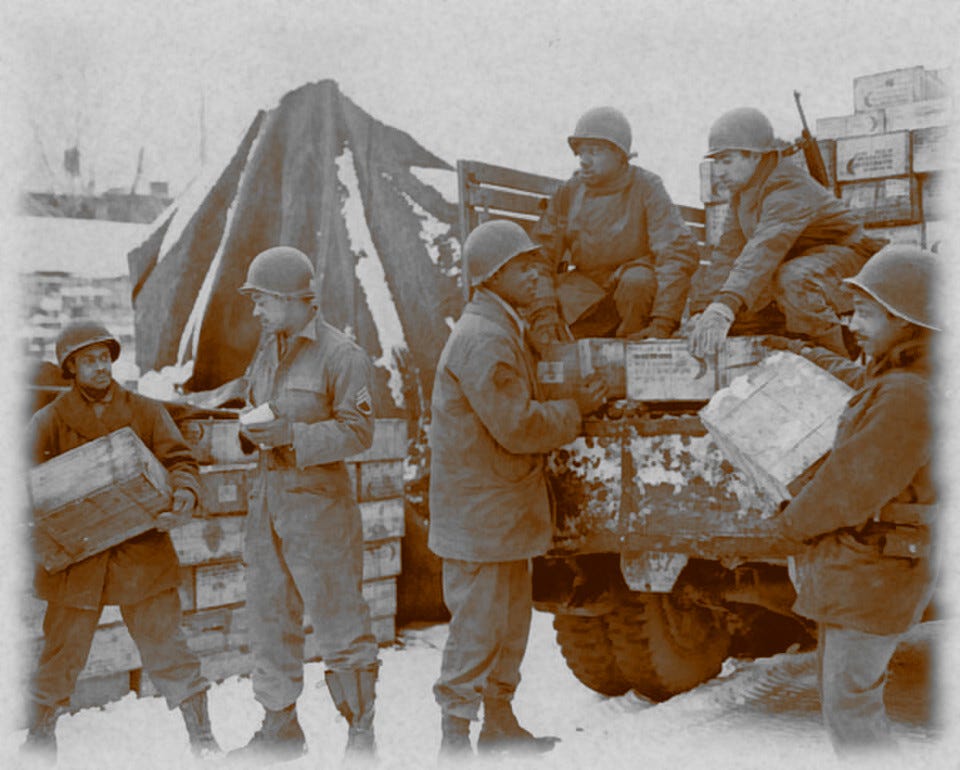
Forming the majority of the Red Ball Express units, African American truck companies not only hauled the supplies that sustained the advance but repeatedly left their vehicles to engage the enemy directly, earning praise from combat commanders for their gallantry under fire. The composition of the Motor Transport Service was a direct reflection of the U.S. Army’s segregated personnel policies, which funneled nearly seventy-five percent of African American enlistees into service and supply roles. Within the 132 truck companies of the Red Ball Express, approximately seventy to eighty percent of the personnel were African Americans, serving in units such as the 3683rd and 3912th Quartermaster Truck Companies. These men operated under the separate but equal doctrine of the War Department, a structural reality that often resulted in inferior equipment and living conditions compared to white combat formations. Despite this systemic stratification, these soldiers formed the logistical backbone of the European Theater of Operations, executing a high-intensity transport mission that General Dwight D. Eisenhower’s headquarters deemed critical to the survival of the 12th Army Group.
The performance of these companies was marked by a relentless operational tempo that blurred the distinction between the rear echelon and the front line. African American Quartermaster units were asked to do the job of supplying Eisenhower’s armies under conditions of extreme sleep deprivation and physical fatigue, and they performed it well. Drivers often operated in teams of two, alternating shifts behind the wheel for forty-eight to seventy-two hours to ensure that the Red Ball convoys never stopped moving toward the depots at Chartres and Dreux. This sustained effort required not only incredible skill, but a high degree of organizational discipline to navigate the loop without the benefit of standardized road lighting, often relying on cats-eye blackout markers to avoid detection by the Luftwaffe. The success of the August-September surge was predicated on the physical endurance of these men, who remained on the road even as the infantry they supported outpaced the reach of the Signal Corps and established lines of communication.
The courage of these drivers frequently manifested in voluntary combat actions that exceeded the requirements of their logistical MOS (Military Occupational Specialty). During the pursuit across northern France, Brig. Gen. Charles Lanham, at the time a colonel commanding the 22d Infantry of the 4th Division, documented the gallantry of these African American soldiers as they encountered the retreating remnants of the Wehrmacht. Lanham observed that African American truck drivers were frequently leaving their trucks to engage German soldiers who had taken cover in the hedgerows or woods adjacent to the supply routes. He personally witnessed these soldiers “whooping it up” as they cleared pockets of resistance near the Seine, and he received numerous reports from his battalion commanders regarding their voluntary participation in fire missions. These actions demonstrated a tactical initiative that contradicted the prevailing prejudices of the contemporary American military establishment, which frequently questioned the combat efficacy of African American troops.
The integration of logistical support and direct combat action by African American Quartermaster units provided a critical tactical buffer for divisions like the 4th Infantry and the 2nd Armored during the race to the Meuse. In the sector around Saint-Dizier, truck companies often found themselves serving as the only available screening force for their own convoys against German Jagdkommando stragglers. The drivers’ willingness to leave their vehicles and participate in mop-up operations allowed the primary combat formations to maintain their forward momentum without being diverted by the necessity of clearing their own rear areas. This gallantry under fire earned the respect of frontline officers who saw these men not merely as laborers, but as essential partners in the destruction of the German Seventh Army. Their conduct established a record of bravery that challenged the racial assumptions of the War Department and laid the groundwork for the later emergency integration of individual African American volunteers into white combat units during the Ardennes Offensive. Through such actions the Red Ball Express became far more than a supply operation. It stood as a testament to the skill, courage, and overlooked importance of African American soldiers in sustaining the greatest Allied advance of the war.
The Legacy of a Logistical Victory and the Men Who Made It Possible
Although the public soon forgot the great logistical battles of 1944–45, the Red Ball Express endured in the memory of ETO veterans, in the admiration of critics like Chester Wilmot, and in the later resurrection of its name, symbolizing American adaptability and the decisive logistical victory won by African American drivers. This institutional memory was solidified by the post-war reflections of Supreme Allied Commander Dwight D. Eisenhower. In his memoir, Crusade in Europe, Eisenhower noted that the Soviet High Command made one pressing demand on him during the early months of the Allied occupation of Germany. Rather than inquiring into the tactical specifics of the M4 Sherman or the intricacies of the Cobra air-ground coordination, the Soviets requested a comprehensive explanation of the supply arrangements that enabled the great sweep out of the congested Normandy beachhead. To the commanders of the Red Army, the ability of the 12th Army Group to cover the vast distances of France, Belgium, and Luxembourg in a single, sustained rush up to the German border represented the most significant military innovation of the Western Front.
This logistical feat compelled even the most cynical observers of American military doctrine to acknowledge a unique national aptitude for massed movement. Chester Wilmot, the Australian war correspondent and historian who was often highly critical of American methodology in his seminal work The Struggle for Europe, nevertheless heaped praise on the American genius for movement and maneuver. Wilmot argued that the fundamental German miscalculation of 1944 was the failure to appreciate that America’s military prowess was a consequence of her industrial power. He observed that, more than any other people of the era, the Americans were “mechanically minded” and possessed a self-confidence in machines which European armies, often still tethered to horse-drawn transport, did not know. In the context of the Red Ball Express, this meant that to the American troops driving across France, distance was not a barrier but an obstacle to be overcome through the application of internal combustion and organizational discipline.
The American press recognized the Red Ball Express as the expression of the nation’s industrial character. Time magazine, reporting in September 1944 as the convoys reached their peak tonnage, saw the operation as symbolic of Americans “as a nation of builders and movers.” This media narrative framed the logistical effort not as a secondary support function, but as a revival of the frontier spirit adapted for the requirements of modern, mechanized warfare. Wilmot echoed this sentiment, noting that the rapid American pursuit across the French interior was effectively a motorized version of the westward expansion, where the technical mastery of the deuce-and-a-half replaced the wagon train. By framing the Red Ball Express in these terms, contemporary observers elevated the truck driver to a status commensurate with the infantryman, recognizing that the American way of war was as much about the delivery of mass as it was about the application of fire.
The Red Ball Express eventually became the primary historical yardstick by which Allied sustainment efforts were measured, representing the one area of warfare—logistics—where the Americans excelled beyond all other armies. Military critics, including former officers of the Wehrmacht and British staff planners, stood in awe of the American Army’s ability to move vast quantities of materiel and hundreds of thousands of men rapidly across distances that would have paralyzed the supply lines of the 21st Panzer Division or the British Second Army. The sheer scale of the operation, which bypassed the traditional reliance on railheads to create a 500-mile rolling depot system, remained a capability that other armies could not duplicate. This excellence in logistics ensured that the Allied command could maintain an operational tempo that consistently outpaced the German ability to establish a coherent defensive line between the Seine and the Siegfried Line.
The legacy of the operation persisted within the U.S. Army’s institutional framework, leading to the repeated resurrection of the Red Ball designation in later twentieth-century conflicts. The name earned such a revered place in the annals of American military history that it was reactivated during the Korean War to describe a high-priority express rail service in Japan used to rush critical supplies to ports for shipment to United Nations forces. During Vietnam, the name was again employed for emergency trucking operations designed to sustain isolated firebases. This continued use of the moniker served as a tribute to the original 1944 system, acknowledging that the Red Ball Express had become a permanent military shorthand for the triumph of logistical improvisation over geographic and infrastructural constraints.
For the veterans of the European Theater of Operations, the Red Ball Express lived on as one of the most enduring legends of the Second World War, a memory defined by the image of heavily loaded trucks and exhausted drivers. While the tactical details of the hedgerow fighting or the river crossings faded for some, the sight of the Red Ball convoys barreling through the night remained a vivid symbol of the American arrival on the European continent. This legend was fundamentally built upon the labor and resilience of African American soldiers, whose performance in the Quartermaster truck companies redefined the role of the service worker in a combat zone. The truck and the driver remained critical on the modern battlefield, a reality proven during the 1991 Gulf War’s Left Hook maneuver and the 2003 drive to Baghdad, both of which relied on the principles of motorized sustainment established on the routes nationales of France. In the end, the Red Ball Express was a defining demonstration that logistics, powered by the courage of the African American soldiers in charge of those logistics, could decide the outcome of modern war.
What the Red Ball Express Reveals About Power, Race, and American Warfare
The Allied success in the 1944 European campaign was ultimately secured by the Red Ball Express, which mitigated the logistical paralysis caused by the destruction of the French rail network and the extreme speed of the pursuit through the sustained, combat-oriented labor of segregated African American transport units. The interdiction of the French rail system, while essential for the isolation of the Normandy bridgehead, created an infrastructure vacuum that nearly suffocated the Allied advance once the 12th Army Group achieved its operational breakout at Avranches. The transition from a static, rail-centric supply model to the fluid, truck-based economy of the Red Ball Express required a radical reorientation of American motorized assets and a departure from orthodox sustainment doctrine. This logistical pivot relied upon the conversion of the deuce-and-a-half truck into a mobile extension of the combat zone, following the armored spearheads of the First and Third Armies across the Seine and toward the German border. This improvised victory was won through the endurance of the African American soldiers of the Quartermaster Corps, who navigated the routes under constant threat of air attack and ambush to bridge the widening gap between the beachhead and the frontier.
The Red Ball Express illustrates the inherent friction between strategic air bombardment and the subsequent requirements of ground sustainment, revealing that the destruction of an enemy’s mobility often imposes an equal tax on the victor’s progress. It demonstrates that in warfare, the distinction between combatant and support personnel is an administrative convenience that frequently collapses under the pressure of enemy resistance and the demands of continuous movement. The indispensable contribution of African American drivers in a segregated army underscored a fundamental operational reality. The technical and physical resilience of these specialized transport formations was as vital to the defeat of the Wehrmacht as the firepower of the infantry divisions they sustained. The 1944 campaign proved that an army’s reach is determined not by the audacity of its maneuvers but by the capacity of its motor transport, and the men assigned to them, to transform industrial production into frontline momentum.
See Also


Bibliography/Further Reading
Colley, David. The Road to Victory: The Untold Story of World War II’s Red Ball Express. 1st ed. Brassey’s, 2000.
Keegan, John. The Second World War. Penguin Books, 2005.
Stewart, Richard W., ed. American Military History : The United States Army in a Global Era, 1917-2010. Vol. 2. Center of Military History, United States Army, 2010.
Great read with a lot of irony: the Allies of 1944 faced the same logistical problems the Germans did in 1940, which slowed their advance and contributed to the success of the Dunkirk evacuation.
Great stuff