

Mercury’s Crucible
The Battle of Crete and the High Cost of Airborne Ambition

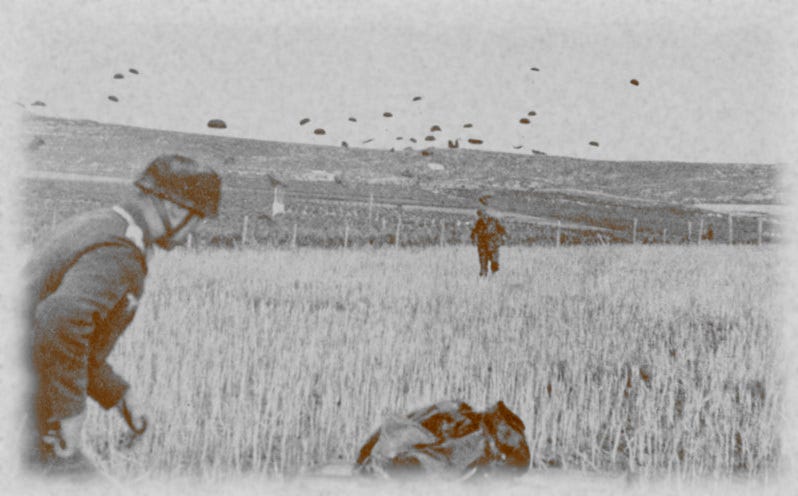
In the warm, blue waters of the Mediterranean, some sixty miles off the Peloponnese coast, sits the slender island of Crete. Out of the early morning skies of May 1941, thousands of German paratroopers floated onto the slim island below—a lethal rain from the clear azure. This audacious airborne assault introduced vertical envelopment as a central element of combined arms warfare. Known as Operation Merkur (Mercury), this unprecedented airborne invasion exposed both the promise and perils of seizing territory from the air, forever changing how battles would be waged beyond the constraints of land and sea.
The Battle of Crete unfolded through the intricate interplay of airborne innovation, intelligence foresight, and relentless ground resistance. This convergence revealed how mass vertical assaults could disrupt conventional warfare while exposing its dependence on air supremacy and rapid consolidation, prompting a doctrinal evolution that would walk a fine line between daring and caution as the war progressed.
The Road to an Airborne Gamble
As Axis forces consolidated in the Balkans after the Greek campaign, the choice to invade Crete through an airborne raid emerged from a blend of opportunistic planning and strategic necessity, setting the stage for an operation that tested the limits of rapid deployment against a forewarned but under-equipped defender. Germany drew the bulk of its oil from Romania’s Ploesti fields, and Allied naval and air bases in the Mediterranean constituted a direct threat to this vital strategic resource. The necessity of denying the enemy air and land access to the Balkans was at the forefront of the Führer’s mind when considering Operation Mercury. However, a problem confronted Germany—it lacked a navy capable of seaborne landings in order to secure these island bases. It did, however, possess the most fearsome air force in the world, and the Luftwaffe was tasked with airlifting troops and equipment to the island in order to wrest it away from its British, New Zealand, and Australian defenders. Deliberations ensued prior to the invasion among the Oberkommando der Wehrmacht officers, many of whom preferred Malta to Crete as the primary target.
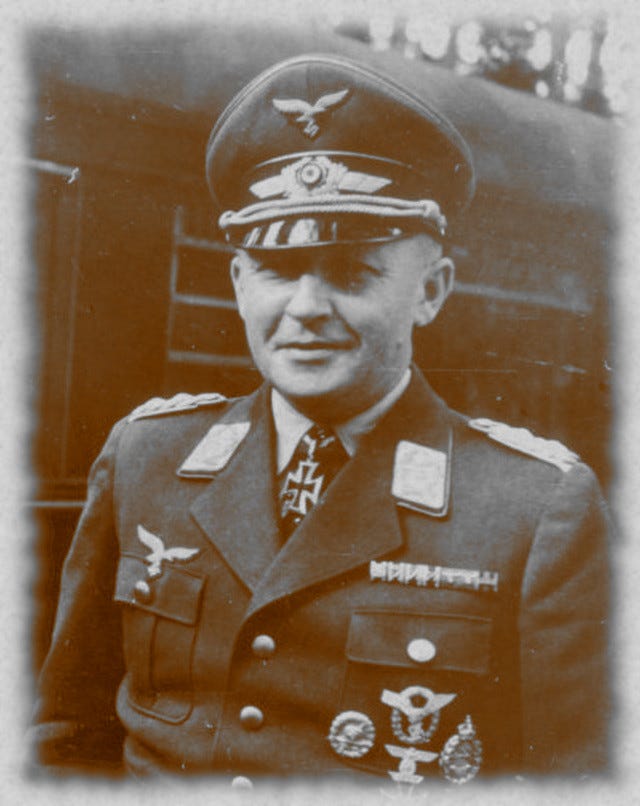
However, General Kurt Student, who had been appointed inspector of Fallschirmjäger troops in 1938 and recognizing the limitations of the Luftwaffe, argued that Crete, being a long, slender island with a single main road, was the ideal target—he further argued that Malta was too heavily garrisoned by British forces. Though larger numerically, the Cretan garrison of roughly 40,000 troops were recently arrived after being battered during the Balkan campaign. The Maltese garrisons—numbering a little over half the Cretan garrison—were fresh troops with artillery and air support. After initial hesitation, Hitler gave the green light for Operation Merkur through Führer Directive 28 on 25 April 1941, allocating a force of 22,000 airborne troops, six-hundred Junkers 52 transport aircraft, and eighty towed gliders carrying light tanks for the operation, under the command of General Alexander Löhr. This preparatory mosaic, woven from Axis ambition and Allied improvisation, converged on the island of Crete, where intelligence glimpses foreshadowed the airborne storm about to break.
Seeing the Blow Coming—And Still Being Outmatched
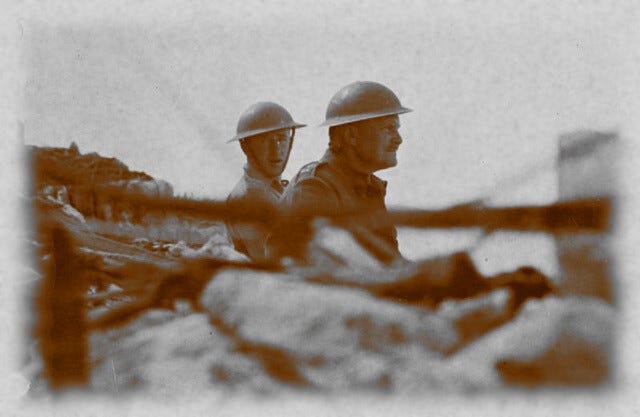
Ultra decrypts provided Allied commanders with unprecedented foreknowledge of the German plan, yet resource constraints limited their ability to counter the assault, illustrating how signals intelligence began transforming defensive strategies in modern warfare. The Germans used the notorious Enigma machine to transmit encoded operational messages from OKW to field commanders. While the army and navy made fewer errors in encoding, making their encryption tougher to break, the relative inexperience of Luftwaffe operators provided Bletchley Park cryptographers with a wealth of information. The cracking of the Luftwaffe Red Key happened in early 1940, providing valuable information to Great Britain’s aerial defense during the winter blitz of 1940-41. Bletchley Park’s success against the Luftwaffe transmissions also provided day-to-day, real-time revelations of the German plans for Mercury, providing commanders with the Axis landing targets of Maleme, Retimo, and Heraklion. However, the problem for the British was not an absence of information, but rather an absence of ability to muster an adequate defense. Major-General Bernard Freyberg—a hero of the Somme in the First World War and recipient of the Victoria Cross—commanded the defense force. He had little to work with. The Allied forces in Crete lacked proper equipment and aircraft. Mortar crews were without baseplates, and machine gunners had few tripods to mount their Vickers guns. Artillery and tank support was virtually non-existent, and air cover consisted of seventeen Hawker Hurricanes and obsolete Gloster Gladiator biplanes, which simply could not keep pace with faster monoplanes. Compounding the dauntless task ahead of General Freyberg was an inadequate number of radios, resulting in a lack of maintaining a clear battle picture, no matter how much of the Mercury battle plan had been revealed to Bletchley cryptanalysts. Even the most qualified commander would have great difficulty overcoming such structural deficiencies. Despite the inherent weaknesses, the defenders braced themselves, as best as possible, at the targeted airfields on the island, where the airborne onslaught would test the fusion of surprise and preparation in the battle’s opening salvos.
As Above, So Below
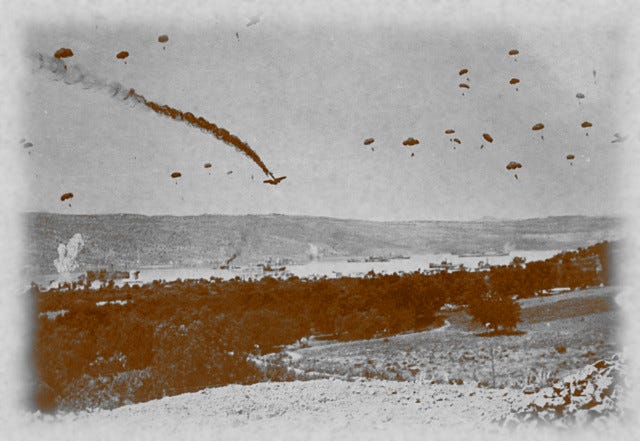
Operation Mercury’s objectives were to secure landing zones for reinforcement at Maleme, Retimo, and Heraklion, where initial chaos and fierce resistance exposed the high-risk calculus of large-scale airborne operations. General Student, rather than concentrating his forces in one area and driving the defenders across the main road of the island, dissipated his assault troops, assigning three regiments per airfield—the 1st Fallschirmjäger Regiment targeting Maleme and Suda Bay, the 2nd targeting Retimo, and the 3rd Regiment targeting Heraklion. The result of dispersion across such a wide area was disastrous. After a pre-assault bombardment that did little to clear the defenders, German Fallschirmjäger regiments descended from the sky in the early morning hours of 20 May. As canopies and the paratroopers attached to them fluttered toward the earth, they came under withering fire from the Allied defensive positions. Between the defensive fires on the descent and fighting on the ground in olive groves, 110 German paratroopers died within the first hour of the invasion. The 3rd Battalion of the 1st Fallschirmjäger Regiment lost approximately 112 killed, wounded, or missing at Maleme, out of its initial assault force of 126. By day’s end, roughly four hundred of the regiment’s six hundred men in the sector were casualties. The 3rd Fallschirmjäger Regiment at Heraklion fared no better, losing their commander in a glider crash at take-off, and its 3rd battalion being almost completely annihilated. Professional soldiers weren’t the only problem for the Germans. Paratroopers that had landed near Modhion were attacked by men, women, and children of the local population, armed with flintlocks, axes, and shovels. Though a handful of the 1st Regiment had some success in Suda Bay, killing 180 men from a defending artillery regiment, the haphazard execution of the initial stages had catastrophic results. The Germans gained reprieve only when New Zealand Lt.Col. Leslie Andrew—another Victoria Cross recipient—made the regrettable decision to withdraw his troops from Maleme airfield, aiming to regroup on high ground and press the counteroffensive the next day. By ceding the airstrip, he allowed Student to reinforce the beleaguered paratroopers. The 2nd Battalion, 100th Mountain Rifle Regiment, crash-landed on the 21st, under blistering machine gun fire on the now-cleared airfield, and the last two companies of Fallschirmjäger troops were paradropped later that afternoon. As control shifted at Maleme, the battle’s mounting toll underscored airborne warfare’s precarious balance, leading to a grueling retreat by Allied forces under Luftwaffe aerial dominance.
Air and Sea Collide
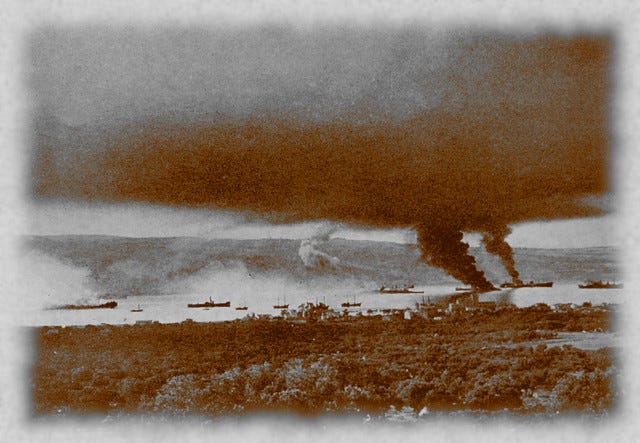
After initial setbacks, the protracted defense crumbled under sustained German pressure, culminating in the harrowing evacuation that highlighted naval vulnerabilities to air power, while the human cost prompted reevaluations of paratrooper utility. As the fighting raged on the ground, at sea, the Royal Navy, attempting to intercept Axis forces approaching the island from the mainland, came under a punishing assault from the Luftwaffe, incurring heavy losses. On 22 May, the HMS Warspite was damaged, and the Royal Navy suffered the losses of cruisers HMS Gloucester and Fiji, along with destroyers HMS Kashmir and Kelly. On the ground, after a failed counterattack in the face of the now reinforced German troops, the defense began to crumble. Following back and forth action around Galatas, the reinforced Germans gained the upper hand and started driving the Allied forces eastward. After alerting Field Marshall Archibald Wavell of the situation on 26 May, Allied forces began evacuating their positions, starting with the Heraklion garrison on the 28th. The Retimo force could not be reached by the navy and had to be abandoned. The main forces east of Maleme trekked through the southern mountains toward the port of Sphakia, where they sought shelter beneath cliffs to protect themselves from the Luftwaffe. The Royal Navy, forced to conduct the rescue operation under cover of darkness due to the fury of Axis air cover, evacuated 18,000 troops by 01 June. 12,000 were left as prisoners, with nearly two-thousand dead—among the losses were two full divisions comprised of British, New Zealand, and Australian troops. The Royal Navy continued to suffer severe losses in its attempt to evacuate Allied forces, losing the cruisers Juno and Calcutta, and the destroyers Greyhound and Imperial by 02 June. The battleship HMS Valiant, the carrier Formidable, along with the cruisers Perth, Orion, Ajax, and Naiad were severely damaged. The destroyers Kelvin, Napier, and Hereward were also damaged during the rescue operation, marking the sea battle of Crete as the costliest engagement of the war for the Royal Navy. German losses amounted to four-thousand—almost as many as the entire Balkan campaign—along with the loss of 220 out of 600 Junkers 52 transport aircraft. German reprisals during the sustained occupation of Crete were brutal, and stained Germany’s reputation on the island. The bitterness lasts to this day. This Pyrrhic victory led Axis planners to temper enthusiasm for unsupported parachute operations, influencing the war’s subsequent airborne chapters.
The Maturing of One Vision, the Burial of Another


Crete’s lessons permeated future operations, where the Allies refined airborne tactics to sidestep its perils, while Germany abandoned large-scale drops completely, constraining its combined arms potential. Despite the victory, Hitler was displeased with the operation, and regarded Crete as proof that the days of paratrooper assaults were over. He also refused to publicize the victory, scrubbing the operation from propaganda. The Allies, however, had a different view. British and American strategists concluded that the execution was the failure, not the form, and that effective airborne operations should consist of dropping troops at a distance from the objective—rather than directly on enemy positions—and then form into a concentrated effort against enemy positions once on the ground. The Allies would heed these conclusions during the Sicily and Normandy campaigns. Market Garden, however, would abandon the lessons learned, and result in complete disaster. Through these doctrinal recalibrations, Crete’s crucible forged a more resilient framework for aerial warfare, extending its influence beyond the Mediterranean.
The Cretan saga’s orchestration of airborne audacity against informed defenses, amplified by airfield struggles and evacuation ordeals, unraveled the complexities of this new form of modern tactical warfare, forging pathways where innovation met the harsh realities of the battlefield. Crete demonstrated that future warfare would pivot to the skies, demanding a synthesis of speed, surprise, and support. Crete’s lessons endure as a beacon for contemporary strategists, where hybrid threats implore the integration of advanced reconnaissance and multi-domain coordination to navigate the perils of innovative tactics and weaponry in an increasingly aerial battlespace.
See Also


Further Reading
Keegan, John. The Second World War. Penguin Books, 2005.
Well done thanks for this. Despite the setback for the German airborne branch in Crete, do you have any idea why the German High Command continued to agree on the formation of Division-scale paratroopers units throughout the war ? Some “Luftwaffe politics” behind this continued effort ?
There was another regimental or division-size drop in July 43 in Sicilia. But that was probably more for defensive purpose and not an assault per se. Any thoughts ? Thanks !
An extremely well-told account. It had me on the edge of my seat.